Multi-ethnic
San Pedro
Two waves of demolition erased the harbor's multi-ethnic waterfront. Terminal Island fell in February of 1942. The Harbor Freeway cut Wilmington a decade later.
1899–1965
The harbor before the demolition
San Pedro and Wilmington grew together around a working port. Fishermen, cannery workers, and stevedores built the neighborhoods along the north shore of San Pedro Bay between the late nineteenth century and the Second World War. The fleet carried Japanese, Croatian, Italian, and Mexican names on its sterns. The canneries along Fish Harbor hired women from every one of those communities. The wharves on Terminal Island, the breakwater at White Point, and the grid of bungalows in Wilmington together formed one of the most ethnically layered waterfronts on the Pacific coast.
The federal government dismantled that waterfront in two sustained waves. The first wave arrived with Executive Order 9066 and the mass removal of Japanese-Americans in 1942. Within three months, the Navy and the Army Corps of Engineers emptied two of the oldest Japanese-American communities in Southern California, Terminal Island and White Point, and razed most of the homes and businesses they left behind. The second wave arrived with concrete. Between 1952 and the early 1960s, the State of California built the Harbor Freeway down the length of Mexican-American Wilmington, splitting the neighborhood from its waterfront and taking several hundred homes. Port expansion and cannery contraction did the rest. By the end of the twentieth century, almost nothing of the prewar waterfront remained on the ground.
The record of who lived here, and who fought to stay, survives because the descendants preserved it. The Terminal Islanders Club, the Los Angeles Conservancy, Densho, the Mural Conservancy of Los Angeles, and the archivists at California State University, Dominguez Hills have kept the oral histories, the photographs, and the buildings in public view. This essay draws on their work. It carries the documentary record of destruction, and it carries, with equal weight, the record of community resistance and recovery.
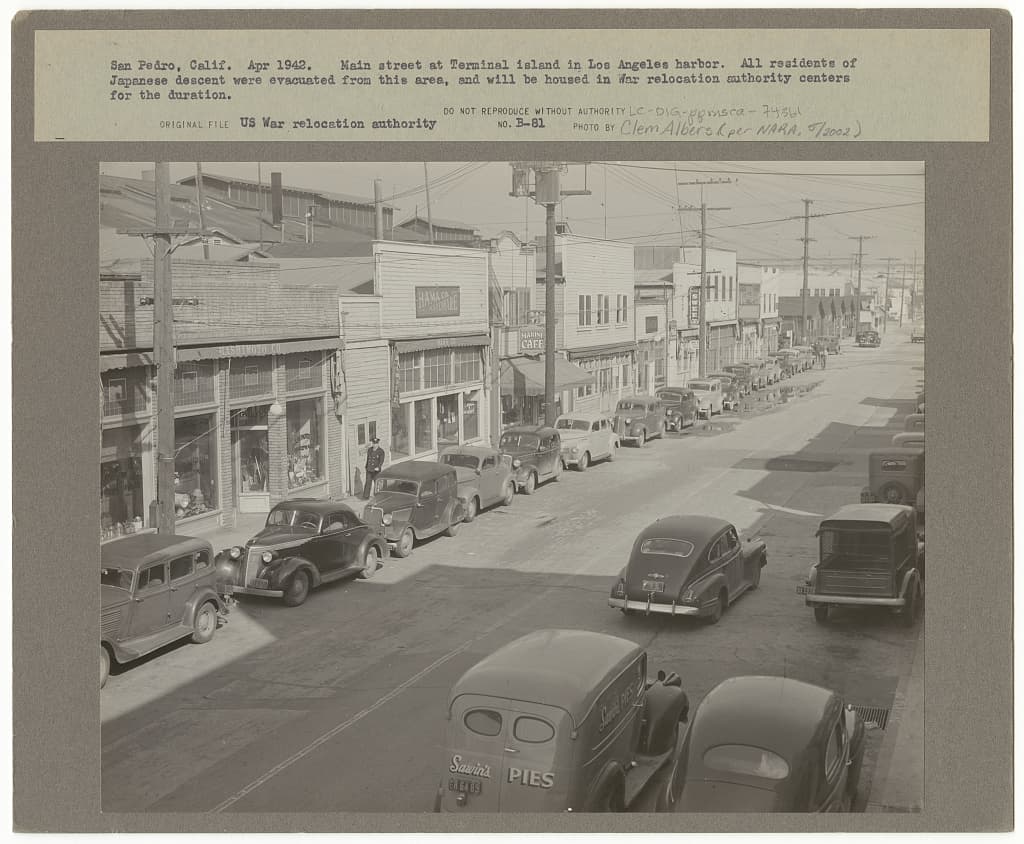
Terminal Island and the Furusato
Japanese immigrants first came to East San Pedro Bay in 1901, when the San Pedro Fishing Company began hiring Issei crews out of the local wharves.1 By the time the Port of Los Angeles finished dredging Fish Harbor in 1917, a dense Japanese-American village had taken shape on the western end of Terminal Island. The residents called the neighborhood “Furusato,” a Japanese word for hometown.2 At its peak in the late 1930s, Furusato held approximately 3,000 residents.1
The village looked like a town because it was one. Tuna Street served as the commercial spine, lined with groceries, barber shops, restaurants, and pool halls. Nanka Shoten opened its doors in 1918; A. Nakamura Company followed in 1923.3 A Shinto shrine, the Daijin-Gu, stood alongside a Baptist church and a Buddhist temple. The Terminal Island Public Elementary School taught the Nisei children of the village in English in the mornings and Japanese in the afternoons.
Furusato developed its own dialect, a Japanese vernacular shaped by the fishing trade and by the second generation’s blending of languages. Former residents remembered the sound of tuna bells on the wharves, the smell of sardine oil from the canneries, and the New Year’s Day celebrations in the shrine yard. Oral histories that the Terminal Islanders Club and CSU Dominguez Hills collected preserve a community that knew itself as Japanese, American, and of the harbor, all at once.4
The removal began on February 2, 1942, when the Navy ordered all adult male “enemy aliens” off the island.1 The FBI had already arrested a long list of Issei fishermen in the raids that followed Pearl Harbor, on the theory that the fishing fleet could serve as a cover for signaling offshore submarines. The Navy issued the general evacuation order on February 25, 1942. Families had 48 hours to leave.2
Families sold furniture, boats, tools, and stock at ten to twenty cents on the dollar because buyers knew the sellers had no time.2 The residents left the island with what they could carry. Most went first to the Santa Anita Assembly Center and from there to Manzanar and to Jerome, in Arkansas.
In the weeks that followed, the Navy and the Army Corps of Engineers bulldozed almost every building in Furusato. When a handful of former residents returned to the island after the war, they found two commercial buildings still standing on Tuna Street, Nanka Shoten and A. Nakamura Company, and nothing else of the community they had left.3 The village’s former footprint became Port of Los Angeles container yards, Coast Guard installations, and, later, the Federal Correctional Institution at Terminal Island. The removal of Furusato is the single most complete physical erasure of any Japanese-American community in the United States. The historian at the Los Angeles Conservancy has called it the only community whose built environment vanished almost entirely.5
White Point and the abalone coast
A second Japanese-American community grew up twenty miles to the west, on the southern shore of the Palos Verdes Peninsula. In 1899, twelve Japanese fishermen leased a stretch of beachfront from Ramon Sepulveda at White Point and began diving for abalone and trapping lobster along the rocky shore.6 By 1903, the divers had earned enough to build a cannery on the cliff above the water. Japanese boats worked the kelp beds from White Point out to Point Fermin and San Clemente Island. By the First World War, the abalone fishery had made the White Point camp one of the most productive Japanese enterprises on the Southern California coast.
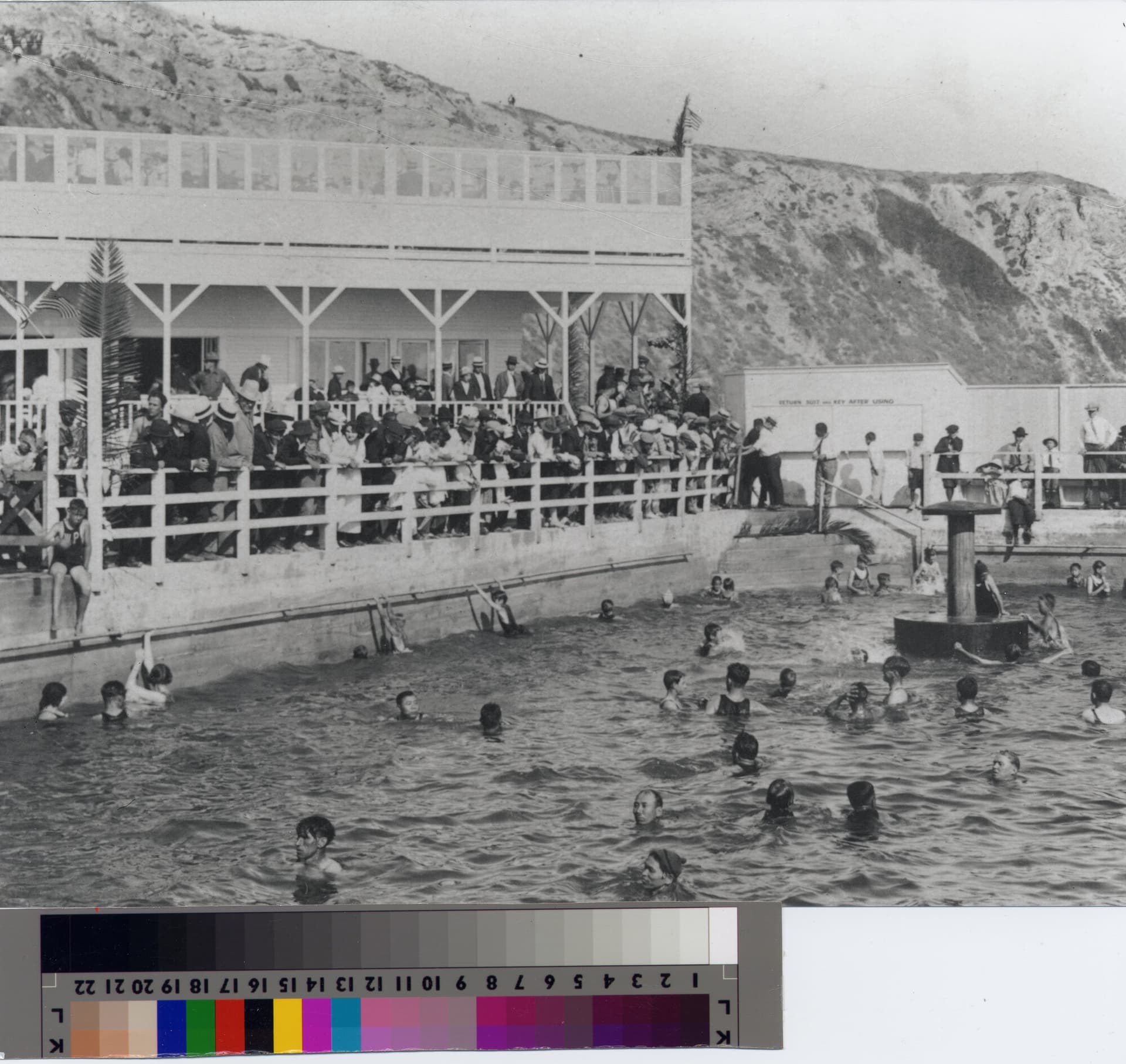
In 1915, Tojuro Tagami and Tamiji Tagami, with Sepulveda’s backing, began converting the site into a resort around the sulfur spring at the base of the cliffs.6 By the mid-1920s, the Royal Palms Hotel stood on the bluff with a restaurant, three salt-water plunges, a bathhouse, and an enclosed boating cove. The resort drew a largely Japanese clientele from across Los Angeles and the Central Valley. Several Japanese families lived on the property year-round. The spa complex was the only Japanese-operated seaside resort of its scale on the West Coast.
On February 7, 1942, five days after the initial Terminal Island order and eighteen days before the general evacuation notice, FBI agents raided White Point and arrested the community’s leaders.6 The remainder of the White Point Japanese community left for the assembly centers that spring. The federal government seized the land and folded it into the coastal defense perimeter of Fort MacArthur. Crews demolished the Royal Palms Hotel. Silt filled the swimming cove. The bathhouse collapsed.
The site passed to Los Angeles County after the war and now operates as White Point and Royal Palms Beach, a county park. A single plaque along the bluff marks the Japanese community that built the resort, and the ruins of a few stone terraces remain visible at low tide. The scale of what stood there, and the scale of what the government removed, is almost entirely absent from the landscape a visitor encounters today.
Fish Harbor, the canneries, and the women who ran the floor
The wharves around Fish Harbor produced more than fish. They produced, for half a century, one of the most important multi-ethnic labor economies in Southern California. The Port of Los Angeles finished dredging Fish Harbor in 1917. By 1918, canneries stood along the wharves in a nearly continuous line.7 Van Camp Sea Food, which the Van Camp family had purchased from Wilbur Wood in 1914, occupied the largest of the early plants. The French Sardine Company of California, founded in 1917 by the Croatian immigrant Martin Bogdanovich and several partners, operated alongside it.8 The French Sardine Company renamed its flagship brand StarKist in the 1940s and took the company name in 1953. By the late 1920s, Fish Harbor held nine canneries and supplied a substantial share of the tuna and sardines that Americans ate.
The cannery floors employed close to 2,000 workers at peak, most of them women. Mexican-American, Yugoslav, Italian, and Japanese-American women stood side by side on the cleaning lines. The men ran the boats and the reduction floors. The women scaled, boned, cut, and packed. The work was wet, cold, fast, and seasonal. The packers earned piecework rates that moved with the season and with the species.
Vicki L. Ruiz’s Cannery Women, Cannery Lives remains the authoritative history of what happened on those floors. Ruiz traced how Mexican-American women built the United Cannery, Agricultural, Packing, and Allied Workers of America, a CIO affiliate, into one of the seventh-largest industrial unions in the country by the end of the 1930s.9 UCAPAWA organized the Southern California canneries across ethnic lines. It negotiated maternity leave, company-provided day care, paid vacations, and seniority rights, benefits that, as Ruiz noted, many of the women’s granddaughters no longer enjoy on the line today. The locals ran themselves. Mexican-American women served as local presidents, as shop stewards, and as bargaining-committee chairs.
The war broke the union’s multi-ethnic base. When the government removed the Japanese-American workers in early 1942, the cannery labor pool lost a substantial fraction of its Nisei women overnight. The wartime expansion refilled the floors with new Mexican-American and Anglo workers, but the political alliances that UCAPAWA had built did not fully survive. By 1950, the Teamsters and the red-baiting campaigns of the McCarthy years had pushed UCAPAWA out of the California food-processing industry. The locals dissolved or affiliated with craft unions that did not share UCAPAWA’s racial or gender politics.
Cannery work on Fish Harbor went on for another half century under those weaker contracts. The industry contracted steadily from the late 1960s as the tuna fleet moved to American Samoa and as sardine stocks collapsed. The last cannery in San Pedro closed in 2001. The StarKist plant on Terminal Island now stands empty, and local preservationists continue to contest proposals to demolish it for container storage.7
San Pedro runs along the north shore of the Los Angeles harbor. Terminal Island, at the center, held a Japanese-American fishing village of three thousand people from about 1910 until the federal government evacuated the island in forty-eight hours in February of 1942 and later bulldozed the homes. The Mexican-American community in Wilmington, just inland, lost its street grid to the Harbor Freeway through the 1950s. The map shows the pre-demolition blocks, the freeway's footprint, and the surviving Japanese memorial site.
The map shows San Pedro and Wilmington, Terminal Island village, 1901 to 1942, White Point community, 1899 to 1942, Fish Harbor cannery district, Mexican-American Wilmington, through 1952, and Harbor Freeway I-110, 1952 to 1965.
- San Pedro and Wilmington
- Terminal Island village, 1901 to 1942
- White Point community, 1899 to 1942
- Fish Harbor cannery district
- Mexican-American Wilmington, through 1952
- Harbor Freeway I-110, 1952 to 1965
Urban Renewal Atlas, illustrative boundary.; Approximate extent based on Densho Encyclopedia, CSU Dominguez Hills oral histories.; Approximate site of the Royal Palms Hotel and Japanese abalone settlement.; Dredged 1917; canneries operated to 2001. Source: Ruiz, Cannery Women (1987).; Approximate extent before Harbor Freeway construction.; Interstate 110 alignment..
The Harbor Freeway through Wilmington
The second wave of destruction arrived from the land side. The Collier-Burns Highway Act of 1947 raised California’s gasoline tax and dedicated the revenue to a new statewide freeway network.10 Los Angeles County voters had approved the general freeway program earlier the same year. The Harbor Freeway, now Interstate 110 and California State Route 110, was one of the first major projects the act funded. The planners laid out a north-south route from downtown Los Angeles to the Port of Los Angeles through the neighborhoods along Figueroa Street and south through Wilmington.
The first section opened on July 30, 1952, between the Four Level Interchange and Third Street downtown.11 The southward extensions proceeded through the 1950s. The segments that cut through the predominantly Mexican-American blocks of Wilmington reached completion in the early 1960s. The route took several hundred homes along the way and severed Wilmington’s residential grid from the waterfront that had shaped it.12
The record on Wilmington’s displacement runs through city planning reports, parish records, and the oral histories held by community organizations in the harbor area. The neighborhood that the freeway cut was a Mexican-American working-class district of bungalows, corner stores, and parish churches, much of it built to house cannery workers, longshoremen, and oil-refinery labor. The residents had little formal input into the route. The homeowners who received eminent-domain offers had no organized legal counsel. The renters, who made up a substantial share of the displaced households, received nothing.
The contrast with Beverly Hills, which successfully resisted a proposed cross-town freeway along the Route 2 corridor through the same period, is the single most reliable marker of the racialized geography of postwar California freeway planning. The state first proposed the Beverly Hills Freeway in the late 1940s. Residents, merchants, and the Beverly Hills city council organized, litigated, and lobbied. The city council reversed its longstanding support for the project in 1971, and the California Transportation Commission erased the Beverly Hills Freeway from the state highway map in 1975.13 The wealthier, whiter, and politically better-organized neighborhood kept its street grid. Wilmington did not. Both decisions passed through the same California Division of Highways, under the same state law, using the same eminent-domain authority.
The Harbor Freeway’s construction through Wilmington coincided with a parallel restructuring of the waterfront. The Port of Los Angeles consolidated the former Terminal Island lots into container yards through the 1960s and 1970s. The freeway’s southern terminus fed directly into the expanding container port. The two projects together converted the harbor from a mixed landscape of homes, canneries, fishing wharves, and small industry into a single industrial throughput zone. The communities who had lived along the water for two or three generations lost access to it within twenty years.
Resistance, memory, and the living record
The communities did not accept the erasure as final. The Terminal Islanders Club, a group of former residents and their descendants, has met twice a year since the 1970s to recover the record of Furusato. The club began collecting oral histories from surviving villagers in that decade, and the project has continued through two generations of interviewers. In 2002, the club dedicated the Terminal Island Japanese Memorial at Fish Harbor on Terminal Island.5 The memorial carries a bronze statue of two Issei fishermen at work, a replica of the Daijin-Gu gate, and calligraphy by former Terminal Islanders Club president Yukio Tatsumi.
The CSU Dominguez Hills Archives holds the Terminal Island Personal Histories Collection, which contains thirty-four transcribed oral histories and one digitized memoir.4 The collection is available to researchers and to members of the public. The archive records not only the removal and the camps but the everyday life of the village before 1942, the dialect, the schoolyard, and the fishing season.
Densho, a Seattle-based nonprofit, has digitized the documentary record of Japanese-American incarceration across the entire West Coast. Densho’s Terminal Island entry, and its catalogued oral-history collection, form the most comprehensive secondary-source record of Furusato available online.1 The encyclopedia entry links directly to the National Archives records on the Navy evacuation order.
The Los Angeles Conservancy has campaigned for two decades to preserve the two surviving buildings on Tuna Street. Nanka Shoten and A. Nakamura Company remain on the Conservancy’s endangered list. In February of 2025, Los Angeles City Councilmember Tim McOsker introduced a motion to designate both buildings as Historic-Cultural Monuments. The National Trust for Historic Preservation added the Tuna Street buildings to its America’s 11 Most Endangered Historic Places list in May of 2025.3 The buildings are the last physical remnant of Furusato on the island.
Wilmington’s record of resistance runs along a different track. The Mural Conservancy of Los Angeles has documented and preserved the Chicano mural tradition that emerged on the freeway’s edges in the 1970s and 1980s.14 The murals on Wilmington’s commercial strips and community centers carry the names, the faces, and the histories of the families the freeway displaced. Youth organizations, parish groups, and labor locals in Wilmington have worked with the Mural Conservancy to restore and repaint the murals as the originals weather. The visual record of who lived in Wilmington before 1962 exists because the community painted it on its own walls and kept repainting it.
The Los Angeles Conservancy also runs periodic heritage tours through the harbor’s Japanese-American sites, from the Terminal Island memorial out to the White Point plaque and the surviving Japanese Fishermen’s Hall in San Pedro. The tours draw second-generation and third-generation descendants of the removed families, along with students from the local high schools. The Conservancy’s docents include members of the Terminal Islanders Club.
The combined archive is deep. Researchers who want to study the harbor before 1942 can read oral histories at CSU Dominguez Hills, photograph collections at the Los Angeles Public Library, Densho’s digital holdings, the Mural Conservancy’s database, and the Terminal Islanders Club’s own publications. The record of destruction is in the federal documents: the Navy evacuation order of February 25, 1942; the FBI arrest lists; the California Division of Highways route studies for the Harbor Freeway. The record of the lives destruction cut short is in the archives the communities built for themselves.
What the harbor holds now
The San Pedro and Wilmington waterfront of 2026 looks almost nothing like the waterfront of 1940. Container yards cover most of the former Furusato. The Harbor Freeway runs through the center of Wilmington. The StarKist cannery stands empty, pending a demolition decision the neighbors continue to contest. The Royal Palms Hotel is a foundation outline under sea grass at the base of the Palos Verdes cliffs.
The communities who built those places are still here. Their grandchildren live in San Pedro, in Wilmington, in Carson, and in Long Beach. They have kept the memorials, the murals, the oral-history collections, and the campaigns to save the last two Tuna Street buildings. They are the reason an atlas like this one can carry a factual account of what the federal government and the State of California did to the harbor between 1942 and 1965. The documentation exists because the communities refused to let the destruction stand as the whole story. The recovery is not complete. The harbor they built is not coming back. The record of who built it, and whom the government removed from it, is in public hands.
Footnotes
-
Densho Encyclopedia, “Terminal Island, California,” 2024. https://encyclopedia.densho.org/Terminal_Island,_California/ ↩ ↩2 ↩3 ↩4
-
Discover Nikkei, “Furusato: The Lost Japanese Fishing Village Between Los Angeles’ Ports,” 2018. https://discovernikkei.org/en/journal/2018/6/19/furusato/ ↩ ↩2 ↩3
-
Los Angeles Conservancy, “Terminal Island ‘Furusato’ Tuna Street Buildings.” https://www.laconservancy.org/learn/historic-places/tuna-street/ ↩ ↩2 ↩3
-
California State University, Dominguez Hills, Terminal Island Personal Histories Collection. https://csudharchives.libraryhost.com/repositories/6/resources/475 ↩ ↩2
-
Los Angeles Conservancy, “Japanese American History at Terminal Island.” https://www.laconservancy.org/japanese-american-history-at-terminal-island/ ↩ ↩2
-
History, Los Angeles County, “White Point and Royal Palms,” March 2014. http://historylosangeles.blogspot.com/2014/03/white-point-and-royal-palms_1.html ↩ ↩2 ↩3
-
Random Lengths News, “Historic Star-Kist Cannery Threatened,” December 16, 2021. https://www.randomlengthsnews.com/archives/2021/12/16/historic-star-kist-cannery-threatened/37184 ↩ ↩2
-
StarKist, Wikipedia. https://en.wikipedia.org/wiki/StarKist ↩
-
Vicki L. Ruiz, Cannery Women, Cannery Lives: Mexican Women, Unionization, and the California Food Processing Industry, 1930–1950, University of New Mexico Press, 1987. ↩
-
California Highways, “Chronology of California Highways Phase IV: Building the Freeway System (1947-1962).” https://cahighways.org/chrphas4.html ↩
-
Gribble Nation, “The Harbor Freeway (Interstate 110 and California State Route 110),” May 2022. http://www.gribblenation.org/2022/05/the-harbor-freeway-interstate-110-and.html ↩
-
Segregation by Design, “Harbor Freeway (I-110).” https://www.segregationbydesign.com/los-angeles/harbor-freeway-i110 ↩
-
LAist, “The Little Known History Behind LA’s Most Tolerable Freeway.” https://laist.com/news/the-2-freeway-echo-park-silver-lake-beverly-hills ↩
-
Mural Conservancy of Los Angeles, Murals Database. https://www.themcla.org/murals ↩
Sources
Densho Encyclopedia. (2024). "Terminal Island, California".
https://encyclopedia.densho.org/Terminal_Island,_California/Reference article on the Japanese-American fishing village, the 1901 settlement date, the Fish Harbor dredging, and the February 1942 Navy evacuation order.
Dominguez Hills California State University. (1994). "Terminal Island Personal Histories Collection".
https://csudharchives.libraryhost.com/repositories/6/resources/475Archival collection of thirty-four transcribed oral histories and one digitized memoir from former Terminal Island residents.
Vicki L. Ruiz. (1987). "Cannery Women, Cannery Lives: Mexican Women, Unionization, and the California Food Processing Industry, 1930–1950". Albuquerque: University of New Mexico Press.
Authoritative history of Mexican-American women cannery workers and the UCAPAWA locals in Southern California, cited for the multi-ethnic cannery labor history of Fish Harbor.
Discover Nikkei. (2018). "Furusato: The Lost Japanese Fishing Village Between Los Angeles' Ports".
https://discovernikkei.org/en/journal/2018/6/19/furusato/Feature article that reconstructs daily life in the Terminal Island village, the 48-hour evacuation notice of February 25, 1942, and the pricing of forced sales by departing families.
Los Angeles Conservancy. (2025). "Terminal Island 'Furusato' Tuna Street Buildings".
https://www.laconservancy.org/learn/historic-places/tuna-street/Preservation file on Nanka Shoten (1918) and A. Nakamura Company (1923), the two surviving buildings from the Japanese-American village on Terminal Island.
Los Angeles Conservancy. (2025). "Japanese American History at Terminal Island".
https://www.laconservancy.org/japanese-american-history-at-terminal-island/Conservancy overview of Terminal Island's Japanese-American community, the 2002 memorial, and the Terminal Islanders Club's preservation work.
History, Los Angeles County. (2014). "White Point and Royal Palms".
http://historylosangeles.blogspot.com/2014/03/white-point-and-royal-palms_1.htmlLocal history account of the 1899 Japanese abalone camp at White Point, the Tagami family's Royal Palms resort, and the February 7, 1942 FBI raid.
Random Lengths News. (2021). "Historic Star-Kist Cannery Threatened".
https://www.randomlengthsnews.com/archives/2021/12/16/historic-star-kist-cannery-threatened/37184Reporting on the StarKist cannery on Terminal Island, its origins as the French Sardine Company of California in 1917, and the 2001 closure of the last San Pedro cannery.
Wikipedia. (2025). "StarKist".
https://en.wikipedia.org/wiki/StarKistReference entry on the French Sardine Company of California, Martin Bogdanovich, and the StarKist brand history.
California Highways. (2024). "Chronology of California Highways Phase IV: Building the Freeway System (1947–1962)".
https://cahighways.org/chrphas4.htmlTimeline source for the Collier-Burns Highway Act of 1947 and the early Harbor Freeway construction schedule.
Gribble Nation. (2022). "The Harbor Freeway (Interstate 110 and California State Route 110)".
http://www.gribblenation.org/2022/05/the-harbor-freeway-interstate-110-and.htmlDetailed route history of I-110, cited for the July 30, 1952 opening of the first Harbor Freeway segment and the 1950s-1960s extensions south through Wilmington.
Segregation by Design. (2024). "Harbor Freeway (I-110)".
https://www.segregationbydesign.com/los-angeles/harbor-freeway-i110Visualization and source material documenting the displacement of Black and Latino communities along the Harbor Freeway corridor in the 1950s and 1960s.
Juliet Bennett Rylah. (2023). "The Little Known History Behind LA's Most Tolerable Freeway".
https://laist.com/news/the-2-freeway-echo-park-silver-lake-beverly-hillsLAist history of the proposed Beverly Hills Freeway, the 1971 Beverly Hills city council reversal, and the 1975 removal of the route from the state highway map.
Mural Conservancy of Los Angeles. (2025). "Murals Database".
https://www.themcla.org/muralsDatabase of Los Angeles murals maintained by the Mural Conservancy, cited for the preservation of the Chicano mural record in Wilmington and San Pedro.