Mexican-American
Ventura County
La Colonia in Oxnard, Cabrillo Village in Saticoy, and the citrus-belt strikes in Fillmore, Santa Paula, and Rancho Sespe carry the Mexican-American record of Ventura County.
1898–1979
The plain, the river, and the factory
Ventura County sits on the coastal plain between the Santa Monica Mountains and the Santa Ynez range, north of Los Angeles. The Oxnard Plain rolls flat from the foothills to the Pacific, and the Santa Clara River cuts east to west through the citrus belt of Santa Paula, Fillmore, and Piru. Chumash towns occupied the coast and the river valley for at least ten thousand years before European contact. Muwu, at Point Mugu, held the largest population of any coastal Chumash settlement along the Santa Monica Mountains and served as a ceremonial center for the Lulapin political unit, whose territory stretched from present-day Los Angeles County to Santa Barbara.1 Saticoy takes its name from Sa’aqtik’oy, a Ventureño Chumash village whose name means “it is sheltered from the wind.”2 The Channel Islands, visible from the shore on a clear morning, held Chumash villages for thirteen thousand years.3
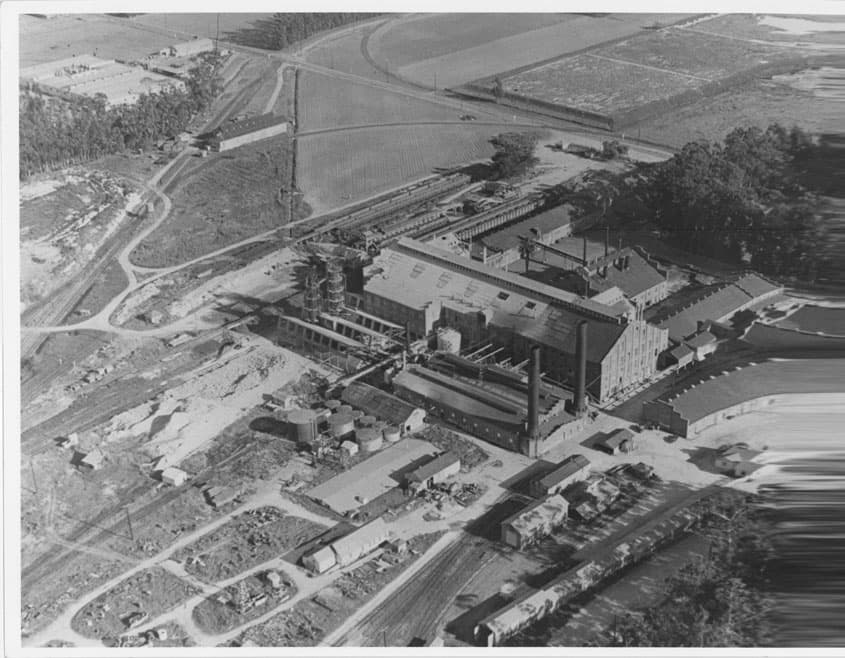
The Spanish mission system, the Mexican ranchos, and then the American land surveys pushed the Chumash off the plain across the nineteenth century. By the 1890s, sugar-beet farmers were planting the land the Chumash had managed as oak savanna and wetland. In 1897, ranchers Albert Maulhardt and Johannes Borchard invited the New York sugar industrialists Henry, James, Robert, and Benjamin Oxnard to build a factory in the coastal plain.4 The brothers spent two million dollars on a hundred-acre site between Fifth Street and Wooley Road. The American Beet Sugar Factory opened on August 19, 1899, ran at a capacity of two thousand tons of beets a day, and at completion was the second-largest sugar-beet plant in the world.5 Henry Oxnard had wanted to name the settlement that grew around the factory after the Greek word for sugar. The state bureaucracy could not parse the transliteration, so he settled for his own family name.4
The factory pulled Chinese, Japanese, and Mexican workers onto the plain faster than the town could absorb them. The Colonia Land Improvement Company laid out a residential tract east of the downtown business district, close to the factory and the beet fields, and named it La Colonia.6 The barrio grew through the first two decades of the twentieth century on a grid of unpaved streets. The city of Oxnard provided paved roads, running water, electricity, and gas to its Anglo neighborhoods long before La Colonia received the same services. La Colonia waited for the basic municipal utilities until the end of the Second World War.6
The essays that follow run from the 1903 sugar-beet strike through the 1979 Rancho Sespe evictions. The arc carries the destruction of Chumash wetlands, the racial covenants that drew the school-district lines around La Colonia, the bracero camps, the citrus-belt strikes, and the single farmworker cooperative purchase that saved a whole village from demolition. The record is thick. The county seat museum, the CSU Channel Islands special collections, Densho, the Bracero History Archive, and two generations of historians at UCLA, Arizona, and CSU Channel Islands have preserved it.
The 1903 strike and the first refusal
The sugar-beet growers who supplied the Oxnard factory contracted their field labor through the Western Agricultural Contracting Company, a grower-controlled firm that skimmed a share of every worker’s wage. By early 1903, the contracting company had cut pay rates twice. Japanese and Mexican field workers organized the Japanese-Mexican Labor Association on February 11, 1903, under the leadership of Kosaburo Baba and J. M. Lizarras, to bargain directly with the growers.7 The JMLA was the first substantial farm labor union in California to organize across racial lines.
The strike began in March. Twelve hundred workers, roughly ninety percent of the sugar-beet labor force in the county, walked off the fields.7 The growers and local law enforcement responded with strikebreakers and arrests. A confrontation on the afternoon of March 23 left one striker dead and several wounded.8 The workers held the line. Within weeks, the American Beet Sugar Company and the contractors conceded a new wage scale that raised piecework rates substantially above the pre-strike level.
The victory produced a test of union politics that carried farther than the wage settlement. The JMLA applied to the American Federation of Labor for a charter. AFL President Samuel Gompers offered to charter the Mexican local as the Sugar Beet Farm Laborer’s Union of Oxnard, with all the rights and privileges of AFL membership, on the condition that the new local “under no circumstance accept membership of any Chinese or Japanese.”9 J. M. Lizarras, the Mexican secretary of the JMLA, refused on behalf of the membership. His June 8, 1903 reply to Gompers survives in the AFL records and in the reprint John Murray published in the American Federationist later that year.9 Lizarras wrote that the Mexican workers would not accept a charter that excluded their Japanese brothers, who had walked out with them and who had been wounded alongside them. The JMLA withdrew the charter request. The union dissolved within a year.
The refusal stands in the record as a plain statement of the multi-racial labor politics the AFL leadership of the early twentieth century worked to suppress. The Mexican workers of the Oxnard Plain chose solidarity over institutional recognition. The choice did not survive as a union, but it survived as a precedent. The historian Tomas Almaguer has read the 1903 strike as the earliest major test of inter-ethnic labor organization in California agriculture, and Frank P. Barajas’s Curious Unions traces the organizing lineage that ran forward from it into the bracero era and the United Farm Workers.10
La Colonia and the school district
The Mexican-American population of La Colonia grew across the first half of the twentieth century on the labor the beet factory and the surrounding ranches demanded. By the late 1940s, the barrio held about eight thousand people, roughly half the farm-labor force of the Oxnard Plain.6 The residents built their own institutions because the city of Oxnard refused to extend them. La Voz de La Colonia, a Spanish-language weekly, published from Oxnard and Santa Paula between 1925 and 1932 and carried news from the barrio that no English-language paper in the county covered. Professor Jose M. Alamillo and Luis Moreno located the surviving bound volumes in the basement of the E. P. Foster Library in Ventura in the 2010s, and the John Spoor Broome Library at California State University Channel Islands has since digitized the collection.11
The school district drew the residential segregation of Oxnard into classroom form. David G. Garcia, Tara J. Yosso, and Frank P. Barajas worked through the Oxnard Elementary School District board minutes from the 1930s through the 1950s and documented the mechanism. The school trustees followed the racial covenants on the property deeds. Covenants of the period permitted non-Caucasian residents on a parcel only “strictly in the capacity of servant” of a Caucasian occupant, and the school district used the same residential map to draw attendance boundaries that kept Mexican children out of the Anglo schools.12
The segregation held for four decades. In 1970, parents in La Colonia filed Soria v. Oxnard School District Board of Trustees in the federal district court for the Central District of California. Judge Harry Pregerson granted summary judgment for the plaintiffs on May 10, 1971, and ordered a remedial integration plan that went into operation in the fall of that year.13 The Ninth Circuit remanded the case on November 27, 1973, for further findings on whether the school board had intentionally segregated the district. Pregerson held a second trial and in December 1974 found that the board had followed a policy of de jure racial segregation from the mid-1930s through the early 1970s.14 The decision is the single authoritative judicial finding on segregation in Oxnard.
The cancelled urban-renewal plan of the early 1960s sits inside this longer record. The city of Oxnard considered a federal urban-renewal designation for La Colonia in the period when the Housing Act of 1949 and its amendments funded the clearance of barrios and Black neighborhoods across California. The proposal became public through the reporting of Don W. Martin in the Ventura County Star-Free Press, whose series in 1963 documented the housing conditions in La Colonia and the scope of the renewal plan the city had commissioned.15 The residents, through community meetings and through La Voz de La Colonia’s successors, organized against the designation. The city council did not adopt the plan. The barrio survived the urban-renewal decade intact, not because the federal government or the city of Oxnard protected it, but because the residents refused to surrender the ground.
La Colonia now holds roughly eighteen thousand people, still majority Mexican-American and still one of the oldest Latino neighborhoods in Ventura County. The HUD Choice Neighborhoods Planning Grant of 2024 awarded the Oxnard Housing Authority and the city five hundred thousand dollars to develop a Transformation Plan for the barrio.16 The planning process brings the same pressures that cancelled the 1963 proposal into a different bureaucratic language. Community-development corporations, the local nonprofit Central Coast Alliance United for a Sustainable Economy, and Choice Neighborhoods residents’ committees have organized public hearings to tether the Transformation Plan to the residents of La Colonia rather than to the developers who want the parcels beneath their homes.17
The bracero camps
The Mexican Farm Labor Program, which the United States and Mexico negotiated as an executive agreement in August of 1942, brought roughly 4.6 million contracts worth of Mexican agricultural labor into the United States over the next twenty-two years.18 Ventura County received a large share of the braceros who worked Southern California fields. The Ventura County Farm Labor Association, the Coastal Growers Association, and the Limoneira Company operated labor camps across the plain and through the citrus belt to house the incoming workers.
Buena Vista, on the outskirts of Oxnard, was among the largest bracero reception and housing facilities in Southern California. The camp functioned as a sorting point for new arrivals from the Mexican reception centers and as long-term housing for the men who worked the Oxnard Plain citrus and row crops. The living conditions ran from adequate to brutal, depending on the contractor and the year. Braceros slept in wooden barracks and ate in collective dining halls. The contractors deducted the cost of food and lodging from the wages the federal agreement had set as the floor. The men worked six days a week, and the program’s administrative structure gave the workers almost no recourse when a contractor violated the terms.
The Bracero History Archive, a joint project of the Smithsonian’s National Museum of American History, the Center for History and New Media at George Mason University, Brown University, and the Institute of Oral History at the University of Texas at El Paso, holds roughly seven hundred interviews with former braceros and their families.18 The archive carries the documentary record of the pay stubs, the contracts, the camp photographs, and the consular files. The Lagomarsino Archives at California State University Channel Islands hold a companion Bracero Oral History Project with about eighty interviews specific to Ventura County, conducted as part of the 2010 Smithsonian traveling exhibition Bittersweet Harvest.19 The interviews carry the Ventura County braceros’ own words on the work, the camps, the discrimination they faced in the towns on their days off, and the families they built on both sides of the border.
The program wound down in 1964. The growers who had relied on bracero labor for two decades had to adjust to a domestic workforce that could organize, bargain, and strike. The adjustment produced the Coastal Growers Association’s mechanization drive and the citrus-belt labor fights that followed. The Coastal Growers Association reduced its Ventura County workforce from 8,517 in 1965 to 1,292 in 1978, while the average hourly wage in the harvest crews rose from $1.77 to $5.63.20 The arithmetic is the measure of what ending the bracero program did to wages, and the measure of what the growers did to employment in the same decade.
Ventura County stretches along the Pacific north of Los Angeles. The Mexican-American communities of Oxnard, Saticoy, Santa Paula, and Fillmore grew around the sugar-beet factory, the citrus orchards, and the farm-labor camps. La Colonia, the Oxnard barrio, faced a cancelled urban-renewal plan in the early 1960s and persistent gentrification pressure since. Cabrillo Village in Saticoy, a thirty-two-acre farm-labor camp, survived because eighty-two families bought it as a cooperative in 1976. The Channel Islands Harbor, carved out of Chumash wetlands in 1960, layers an Indigenous removal on top of the modern record.
The map shows Ventura County coverage, La Colonia, Oxnard, Cabrillo Village cooperative, 1976, Rancho Sespe workers' village, demolished 1979 onward, and Channel Islands Harbor, 1958 to 1965.
- Ventura County coverage
- La Colonia, Oxnard
- Cabrillo Village cooperative, 1976
- Rancho Sespe workers' village, demolished 1979 onward
- Channel Islands Harbor, 1958 to 1965
Urban Renewal Atlas, illustrative boundary.; Approximate extent of the Mexican-American barrio north of downtown Oxnard.; Approximate extent of the farmworker cooperative near Saticoy.; Approximate site of the workers' village the ranch demolished after the 1979 strike.; US Army Corps of Engineers harbor basin, dredged out of the coastal wetlands of the Oxnard Plain..
Cabrillo Village, the flood, and the cooperative purchase
Cabrillo Village sat on a thirty-two-acre lot adjacent to the Santa Clara River, south of Saticoy, on land the Saticoy Lemon Association had operated as a farm-labor camp since the 1930s. The camp housed citrus workers and their families in small wooden cottages. The Saticoy Lemon Association owned the land, owned the houses, and deducted the rent from the workers’ wages. The cottages had no insulation, minimal plumbing, and the flood plain of the Santa Clara River on the south side.
Three major storms from January through March of 1969 pushed the Santa Clara River to the highest flow its gauges have ever recorded, 165,000 cubic feet per second.21 The river breached its north bank, destroyed five bridge crossings across the Santa Clara Valley, flooded the Ventura Harbor, and killed thirteen people across the county.22 The Saticoy bridge washed out, and cars detoured through the riverbed east of the old crossing while county crews rebuilt it. Cabrillo Village sat directly on the flood path. The residents evacuated and came back to the cottages that had survived. The Saticoy Lemon Association announced afterward that the cost of repairs exceeded the value of the camp. The company intended to demolish the cottages and redevelop the parcel.
The residents organized. In 1974, the citrus workers at Cabrillo Village elected the United Farm Workers as their bargaining agent, part of the broader UFW drive through the Ventura County citrus belt.20 The UFW drive gave the residents the organizational structure they used through the next two years of negotiations with the Saticoy Lemon Association. Rodney Fernandez, a housing advocate who had worked with the UFW and with the Catholic Diocese of Monterey, helped the residents think through the purchase of the camp as a cooperative.23 On January 1, 1976, the Saticoy Lemon Association agreed to meet with resident representatives to negotiate a sale of the land and the housing stock.
Eighty-two resident families formed the Cabrillo Improvement Association as a California cooperative corporation and purchased the camp from the Saticoy Lemon Association on May 5, 1976, for eighty thousand dollars.20 The purchase made Cabrillo Village one of the first farmworker-owned housing cooperatives in the United States. Cesar Chavez and the United Farm Workers lent public support through the campaign. The cooperative restructured the rental arrangement as a membership interest, so that the residents’ monthly payments built equity in the cooperative rather than flowing back to the grower who employed them.
The Cabrillo Improvement Association spent the five years after the purchase rehabilitating the cottages, building new units on the parcel, and running the cooperative as a self-governing entity. In 1981, Fernandez and the cooperative’s board incorporated Cabrillo Economic Development Corporation as a separate nonprofit whose purpose was to build farmworker housing elsewhere in Ventura County.20 CEDC has developed more than two thousand affordable units across the county in the four decades since. The Rudy Bruner Award for Urban Excellence recognized Cabrillo Village in 1991 as a model of resident-controlled affordable housing development.23
The Cabrillo Village story runs against the grain of almost every other farm-labor camp in the United States. Most camps passed from grower ownership to demolition or to institutional landlords who extracted higher rents from the same housing stock. Cabrillo Village passed into the hands of the people who had worked the adjacent orchards, and it has remained in those hands for fifty years. The cooperative corporation still owns the land.
The citrus belt, 1968 to 1979
The citrus strikes of the Santa Clara River valley started in the orchards around Fillmore in 1968 and ran through the 1970s in the Limoneira packing houses at Santa Paula, the Sunkist groves around Piru, and the Rancho Sespe holdings between Fillmore and Santa Paula.24 The UFW organized the crews after Chavez moved organizers north from Delano following the 1970 grape contracts. The Ventura County drive produced contracts at Limoneira, at Coastal Growers, and at several of the smaller ranches across the middle of the 1970s.
Rancho Sespe held a particular place in the strike record. The ranch stretched across several thousand acres on the north bank of the Santa Clara River, between Fillmore and Santa Paula. Two residential villages, Oak Village and El Rio, housed several hundred resident workers and their families on the ranch grounds. The Rancho Sespe workers voted to certify the United Farm Workers as their bargaining agent in 1978.25
Newport Beach Development bought the ranch in early 1979. The new owner’s management company, Rivcom, fired the 150 resident workers within weeks of the sale and replaced them with contract labor from Fresno.24 The firing was an eviction in fact: the workers lived in housing tied to the jobs, and losing the jobs meant losing the homes. On February 16, 1979, a hundred residents, including women and children, stopped a bulldozer at Oak Village that Rivcom had sent to demolish the housing while the residents still occupied the units.24 The confrontation produced one of the longest-running labor disputes in Ventura County history. The UFW challenged the firings as unfair labor practices before the California Agricultural Labor Relations Board. The residents held the village for more than a year.
Rafael Haro wrote a corrido, “El Corrido de la Huelga de Rancho Sespe,” that carried the strike into Mexican-American radio and community events across Southern California.26 The song held the names of the ranch, the families, and the company that had sold them out, and it is among the most widely recorded corridos from the late-1970s UFW period. The Museum of Ventura County has catalogued the recording and the supporting strike ephemera as part of its Hispanic heritage collection.26
Rancho Sespe the workers’ village no longer exists. The houses came down through the 1980s, and the residential parcels became part of the current Rancho Sespe Village, a 148-unit affordable-housing development that Cabrillo Economic Development Corporation built on a portion of the former ranch grounds in the 1990s.25 The cooperative model that the Cabrillo Village families had built after 1976 provided the template for the reconstruction at Rancho Sespe. The same institutional memory that saved Cabrillo Village rebuilt a fraction of what the 1979 evictions took from Rancho Sespe.
The harbor on the plain
The US Army Corps of Engineers began construction of the Channel Islands Harbor in 1958. The outer breakwater and the entrance jetties went in between 1958 and 1960, and the Corps dredged the harbor basin out of the sand dunes and coastal wetlands of the Oxnard Plain between 1960 and 1965.27 The project’s nominal purpose was a sand trap. The construction of the Port of Hueneme, a deep-water commercial port a few miles south, had interrupted the natural littoral drift of sand along the coast, and the Corps designed the Channel Islands Harbor as an upstream sand trap, so its dredges could lift the accumulated sand and redeposit it on the Hueneme beaches to slow the erosion the port had caused.27
The harbor’s secondary purpose was recreational, and the secondary purpose absorbed most of the development dollars. Ventura County annexed the shoreside parcels into the city of Oxnard after the Corps handed the basin over in 1965. The county developed the shoreline as a yacht harbor, a fisherman’s wharf, and a set of waterfront apartment complexes across the following two decades. The ground the Corps dredged had held Chumash coastal village sites and salt-marsh habitat. The construction destroyed both. The Chumash archaeological record on the southern edge of the Oxnard Plain remains one of the most significant pre-contact cultural landscapes on the Southern California coast, and the Channel Islands Harbor construction erased a portion of it without documentation that meets any modern preservation standard.1
The Corps’s decision to dredge through the marsh rather than design the harbor around it reflected the land-use logic of the late 1950s federal public-works pipeline. The National Historic Preservation Act did not become law until 1966. The National Environmental Policy Act followed in 1970. The California Coastal Act came in 1976. The Corps and Congress approved, designed, funded, and largely completed the Channel Islands Harbor before any of the three statutes could have slowed it. The harbor sits today on coordinates that held, within living memory, coastal wetlands that fed migratory waterfowl and that the Chumash towns, whose descendants now live in and around Ventura, Santa Barbara, and the Santa Ynez reservation, worked for fish, shellfish, and tule. The Barbareno-Ventureno band of Mission Indians, whose members trace descent from the coastal Chumash towns, continues to work with archaeologists and with the National Park Service at Channel Islands National Park to document the sites the harbor construction removed.3
The living record
The archive of Ventura County’s Mexican-American and Indigenous history is as deep as any county in California. The John Spoor Broome Library at CSU Channel Islands holds the Lagomarsino Archives, the La Voz de La Colonia digital collection, and the Bracero Oral History Project.19 The Museum of Ventura County in downtown Ventura maintains the county’s most significant photograph, ephemera, and oral-history collections, including the Rancho Sespe corrido and the strike documentation.26 The Bracero History Archive online carries the largest open-access collection of bracero interviews and documents in the United States.18
The living organizations that came out of the twentieth-century organizing keep the record active. Cabrillo Economic Development Corporation, the institutional descendant of the 1976 Cabrillo Improvement Association, holds roughly two thousand farmworker and low-income housing units across Ventura County.23 Central Coast Alliance United for a Sustainable Economy runs housing, environmental-justice, and civic-engagement campaigns out of offices in Oxnard and Santa Barbara.17 House Farm Workers, a nonprofit advocacy organization, pushes county government to fund farmworker housing construction and worked on the 360-unit Ventura Ranch proposal that has moved through the county planning process in the last several years.28 The Oxnard Housing Authority and the Choice Neighborhoods residents’ committees carry the La Colonia Transformation Plan forward with the same concerns the 1963 residents raised about displacement, speculation, and the shape of city-led redevelopment.29
The historians who have assembled the primary-source record have worked from the Ventura County side of the record rather than from Los Angeles or Sacramento. Frank P. Barajas, a historian at CSU Channel Islands, published Curious Unions in 2012 and Mexican Americans with Moxie in 2021, and both volumes work out of the county’s archives, newspapers, and living informants.10 15 David G. Garcia’s Strategies of Segregation documents the Oxnard school-district record from the 1930s forward.12 Luis Moreno’s dissertation work and his Education Yes, Segregation No project carry the Soria record into a teaching curriculum.30 Jose M. Alamillo at CSU Channel Islands located and digitized La Voz de La Colonia and continues to publish on the Mexican-American press of the early twentieth century in the region.11
The record of destruction is in the federal documents, the board minutes, the court decisions, and the company records. The Navy Corps project files on the Channel Islands Harbor, the Oxnard Elementary School District board minutes from the 1930s through the 1970s, the Rivcom management records, and the Soria case file all sit in public archives. The record of resistance is in the oral histories, the corridos, the cooperative corporation documents, and the community organizations the residents built for themselves. The two records belong together on the same map. The Mexican-American and Indigenous communities who worked the beet fields, the citrus orchards, and the cannery floors of Ventura County built the economy of the county across a century. They faced the factory closure of 1959, the urban-renewal proposal of 1963, the flood of 1969, the evictions of 1979, and the harbor construction that erased their ancestors’ villages. They are still here. The record they built for themselves is the foundation of everything a present-day reader can know about the county’s twentieth century.
Footnotes
-
UC Santa Barbara Interdisciplinary Humanities Center, “Islands, Interiors, and In Between: Chumash Life on the Oxnard Plain,” research program summary. https://www.ihc.ucsb.edu/islands-interiors/ ↩ ↩2
-
Wikipedia, “Saticoy, California.” https://en.wikipedia.org/wiki/Saticoy,_California ↩
-
John R. Johnson, “The Names and Locations of Historic Chumash Villages,” Journal of California and Great Basin Anthropology. https://escholarship.org/content/qt8833s5k5/qt8833s5k5_noSplash_7575e73a2cc8e9aa52100b7a5a83cfe2.pdf ↩ ↩2
-
Visit Oxnard, “History of Oxnard, California.” https://visitoxnard.com/about/history/ ↩ ↩2
-
Historical Marker Database, “American Beet Sugar Factory Historical Marker.” https://www.hmdb.org/m.asp?m=172231 ↩
-
Wikipedia, “Colonia, Oxnard, California.” https://en.wikipedia.org/wiki/Colonia,_Oxnard,_California ↩ ↩2 ↩3
-
Wikipedia, “1903 Oxnard strike.” https://en.wikipedia.org/wiki/1903_Oxnard_strike ↩ ↩2
-
Erik Loomis, “This Day in Labor History: February 11, 1903,” Lawyers, Guns, and Money, February 11, 2017. https://www.lawyersgunsmoneyblog.com/2017/02/this-day-in-labor-history-february-11-1903 ↩
-
John Murray, “‘A Foretaste of the Orient’: John Murray Criticizes the AFL for Discriminating Against Asian Americans,” American Federationist, 1903, reprinted at History Matters, George Mason University. https://historymatters.gmu.edu/d/5564/ ↩ ↩2
-
Frank P. Barajas, Curious Unions: Mexican American Workers and Resistance in Oxnard, California, 1898-1961, University of Nebraska Press, 2012. ↩ ↩2
-
California State University Channel Islands, John Spoor Broome Library, La Voz de La Colonia Collection. https://library.csuci.edu/collections/special-collections/la-voz.htm ↩ ↩2
-
David G. Garcia, Tara J. Yosso, and Frank P. Barajas, “‘Strictly in the Capacity of Servant’: The Interconnection Between Residential and School Segregation in Oxnard, California, 1934-1954,” History of Education Quarterly 53, no. 1 (2013): 64-89. ↩ ↩2
-
Soria v. Oxnard School District Board of Trustees, 328 F. Supp. 155 (C.D. Cal. 1971). https://law.justia.com/cases/federal/district-courts/FSupp/328/155/1428287/ ↩
-
Soria v. Oxnard School District Board of Trustees, 386 F. Supp. 539 (C.D. Cal. 1974). https://law.justia.com/cases/federal/district-courts/FSupp/386/539/2307887/ ↩
-
Frank P. Barajas, Mexican Americans with Moxie: A Transgenerational History of El Movimiento Chicano in Ventura County, California, 1945-1975, University of Nebraska Press, 2021. ↩ ↩2
-
City of Oxnard, “Choice Neighborhoods.” https://choice.oxnard.gov/ ↩
-
Central Coast Alliance United for a Sustainable Economy, Ventura County office. https://causenow.org/ventura/ ↩ ↩2
-
Bracero History Archive, Smithsonian National Museum of American History, Center for History and New Media at George Mason University, Brown University, and the Institute of Oral History at the University of Texas at El Paso. https://braceroarchive.org/ ↩ ↩2 ↩3
-
California State University Channel Islands, Lagomarsino Archives, Bracero Oral History Project. https://libguides.csuci.edu/chicano-studies/other-resources ↩ ↩2
-
Monica Perales and Luis Alvarez, “Reimagining Resistance, Reconstructing Community: Farmworker Housing Cooperatives in Ventura County, CA, 1965-1990,” Tropics of Meta, January 12, 2024. https://tropicsofmeta.com/2024/01/12/reimagining-resistance-reconstructing-community-farmworker-housing-cooperatives-in-ventura-county-ca-1965-1990/ ↩ ↩2 ↩3 ↩4
-
Wikipedia, “Santa Clara River (California).” https://en.wikipedia.org/wiki/Santa_Clara_River_(California) ↩
-
Ventura County Fire Department, “The Great Flood Ventura County 1969,” commemorative publication, 2019. https://fire.venturacounty.gov/wp-content/uploads/2020/02/1969_Flood_book.pdf ↩
-
Rudy Bruner Award for Urban Excellence, “Cabrillo Village,” 1991 silver medalist. https://www.rudybruneraward.org/winners/cabrillo-village/ ↩ ↩2 ↩3
-
Social Sciences LibreTexts, “Labor Movements: Agricultural Workers,” in Introduction to Ethnic Studies (Fischer et al.). https://socialsci.libretexts.org/Bookshelves/Ethnic_Studies/Introduction_to_Ethnic_Studies_(Fischer_et_al.)/11:_Social_Movements-_Resistance_and_Solidarity/11.05:_Labor_Movements-_Agricultural_Workers ↩ ↩2 ↩3
-
Fillmore Historical Museum, “Rancho Sespe.” https://www.fillmorehistoricalmuseum.org/rancho-sespe ↩ ↩2
-
Museum of Ventura County, “Hispanic Heritage Month: Corrido,” research library feature on “El Corrido de la Huelga de Rancho Sespe” by Rafael Haro. https://venturamuseum.org/connect/hispanic-heritage-month-corrido/ ↩ ↩2 ↩3
-
Wikipedia, “Channel Islands Harbor.” https://en.wikipedia.org/wiki/Channel_Islands_Harbor ↩ ↩2
-
House Farm Workers!, Ventura County farmworker housing advocacy organization. https://housefarmworkers.org/about-us/ ↩
-
City of Oxnard, “Choice Neighborhoods: About.” https://choice.oxnard.gov/about ↩
-
Luis H. Moreno, “Education Yes! Segregation No! The Struggles To End School Segregation In Oxnard, California, 1963-1974.” http://luishmoreno.com/?p=671 ↩
Sources
Frank P. Barajas. (2012). "Curious Unions: Mexican American Workers and Resistance in Oxnard, California, 1898–1961". Lincoln: University of Nebraska Press.
Monograph on Mexican-American labor and community formation in Oxnard from the American Beet Sugar Factory's founding through the closure of the bracero program; primary source for the 1903 strike arc and the mid-century organizing lineage.
Frank P. Barajas. (2021). "Mexican Americans with Moxie: A Transgenerational History of El Movimiento Chicano in Ventura County, California, 1945–1975". Lincoln: University of Nebraska Press.
Covers the post-WWII Chicano movement in Ventura County, including the 1963 La Colonia urban-renewal proposal, Don W. Martin's Star-Free Press reporting, and the Soria school-segregation case.
David G. Garcia, Tara J. Yosso, Frank P. Barajas. (2013). "“Strictly in the Capacity of Servant”: The Interconnection Between Residential and School Segregation in Oxnard, California, 1934–1954". History of Education Quarterly.
Documents the mutually reinforcing racial covenants, residential segregation, and school-district boundary decisions that produced the de jure segregation of Oxnard elementary schools from the 1930s forward.
Bracero History Archive. (2010). "Bracero History Archive".
https://braceroarchive.org/Joint project of the Smithsonian National Museum of American History, the Center for History and New Media at George Mason University, Brown University, and the Institute of Oral History at UTEP; holds approximately 700 bracero interviews and supporting documents.
California State University Channel Islands. (2010). "Lagomarsino Archives: Bracero Oral History Project".
https://libguides.csuci.edu/chicano-studies/other-resourcesApproximately eighty interviews with Ventura County braceros and their families; companion to the Smithsonian traveling exhibition Bittersweet Harvest.
California State University Channel Islands. (2016). "La Voz de La Colonia Collection".
https://library.csuci.edu/collections/special-collections/la-voz.htmDigitized run of the Spanish-language weekly published in Oxnard and Santa Paula between 1925 and 1932; recovered from the E.P. Foster Library in Ventura by Jose M. Alamillo and Luis Moreno.
Wikipedia. (2025). "1903 Oxnard strike".
https://en.wikipedia.org/wiki/1903_Oxnard_strikeReference article on the Japanese-Mexican Labor Association strike against the American Beet Sugar Company, the strike's terms, and the refusal of the AFL charter that would have excluded Japanese members.
Erik Loomis. (2017). "This Day in Labor History: February 11, 1903".
https://www.lawyersgunsmoneyblog.com/2017/02/this-day-in-labor-history-february-11-1903Secondary account of the JMLA formation, the March 1903 strike, the March 23 confrontation that left one striker dead, and the AFL charter refusal.
John Murray. (1903). "“A Foretaste of the Orient”: John Murray Criticizes the AFL for Discriminating Against Asian Americans".
https://historymatters.gmu.edu/d/5564/Reprint of Murray's 1903 American Federationist article, which carries J. M. Lizarras's June 8, 1903 letter rejecting Gompers's charter offer on behalf of the Mexican members of the JMLA.
United States District Court, Central District of California. (1971). "Soria v. Oxnard School District Board of Trustees, 328 F. Supp. 155".
https://law.justia.com/cases/federal/district-courts/FSupp/328/155/1428287/Judge Harry Pregerson's May 10, 1971 summary judgment for the plaintiffs and the remedial integration plan that went into operation in the fall of 1971.
United States District Court, Central District of California. (1974). "Soria v. Oxnard School District Board of Trustees, 386 F. Supp. 539".
https://law.justia.com/cases/federal/district-courts/FSupp/386/539/2307887/December 1974 decision finding that the Oxnard School Board had followed a policy of de jure racial segregation from the mid-1930s through the early 1970s, on remand from the Ninth Circuit.
Luis H. Moreno. (2022). "Education Yes! Segregation No! The Struggles To End School Segregation In Oxnard, California, 1963–1974".
http://luishmoreno.com/?p=671Teaching and research project on the Soria case and the Oxnard school desegregation campaign; includes oral histories and document reproductions.
Wikipedia. (2025). "Colonia, Oxnard, California".
https://en.wikipedia.org/wiki/Colonia,_Oxnard,_CaliforniaReference article on La Colonia, its founding by the Colonia Land Improvement Company, the delayed extension of municipal utilities, and population history.
Historical Marker Database. (2022). "American Beet Sugar Factory Historical Marker".
https://www.hmdb.org/m.asp?m=172231Ventura County Landmark No. 16 marker, carrying the factory's 1898 construction, its $2,000,000 cost, its 2,000 tons/day capacity, and its 1899–1959 operating period.
Visit Oxnard. (2024). "History of Oxnard, California".
https://visitoxnard.com/about/history/Municipal tourism office history of the Oxnard brothers' 1897 invitation from Maulhardt and Borchard, the factory's construction, and the naming of the city.
University of California, Santa Barbara, Interdisciplinary Humanities Center. (2020). "Islands, Interiors, and In Between: Chumash Life on the Oxnard Plain".
https://www.ihc.ucsb.edu/islands-interiors/Research program summary on Chumash settlement, transportation, and interaction on the southern Oxnard Plain; covers Muwu, Simo'mo, and related pre-Contact and Contact-era sites.
Wikipedia. (2025). "Saticoy, California".
https://en.wikipedia.org/wiki/Saticoy,_CaliforniaReference article on Saticoy, including the etymology from Sa'aqtik'oy, the 1887 railroad-era settlement, Cabrillo Village, and the 1969 flood bridge destruction.
John R. Johnson. (1988). "The Names and Locations of Historic Chumash Villages". Journal of California and Great Basin Anthropology.
https://escholarship.org/content/qt8833s5k5/qt8833s5k5_noSplash_7575e73a2cc8e9aa52100b7a5a83cfe2.pdfCatalog of historic Chumash villages along the Santa Barbara Channel, the Oxnard Plain, and the Channel Islands; primary reference for the placement of Muwu and surrounding settlements.
Monica Perales, Luis Alvarez. (2024). "Reimagining Resistance, Reconstructing Community: Farmworker Housing Cooperatives in Ventura County, CA, 1965–1990".
https://tropicsofmeta.com/2024/01/12/reimagining-resistance-reconstructing-community-farmworker-housing-cooperatives-in-ventura-county-ca-1965-1990/Scholarly essay on the Cabrillo Village cooperative purchase in 1976, the Coastal Growers Association's mechanization arithmetic, and the broader farmworker housing cooperative movement in Ventura County.
Rudy Bruner Award for Urban Excellence. (1991). "Cabrillo Village".
https://www.rudybruneraward.org/winners/cabrillo-village/Award file on the Cabrillo Improvement Association's purchase of the thirty-two-acre farm-labor camp from the Saticoy Lemon Association on May 5, 1976, and the subsequent redevelopment under the Cabrillo Economic Development Corporation.
Wikipedia. (2025). "Santa Clara River (California)".
https://en.wikipedia.org/wiki/Santa_Clara_River_(California)Reference article on the Santa Clara River; cited for the 1969 peak flow of 165,000 cubic feet per second, the north-bank breach, and the Ventura Harbor flooding.
Ventura County Fire Department. (2019). "The Great Flood Ventura County 1969".
https://fire.venturacounty.gov/wp-content/uploads/2020/02/1969_Flood_book.pdfCommemorative publication documenting the January through March 1969 storms, the thirteen deaths in the county, the five destroyed bridge crossings, and the $60 million (1969 dollars) in property damage.
Maria Fischer, others. (2023). "Labor Movements: Agricultural Workers". Introduction to Ethnic Studies. LibreTexts.
https://socialsci.libretexts.org/Bookshelves/Ethnic_Studies/Introduction_to_Ethnic_Studies_(Fischer_et_al.)/11:_Social_Movements-_Resistance_and_Solidarity/11.05:_Labor_Movements-_Agricultural_WorkersOpen educational resource chapter covering the Ventura County citrus-belt strikes of 1968–1979, the Rancho Sespe evictions, and the February 16, 1979 Oak Village bulldozer confrontation.
Fillmore Historical Museum. (2023). "Rancho Sespe".
https://www.fillmorehistoricalmuseum.org/rancho-sespeLocal history file on Rancho Sespe, the 1978 UFW certification, the 1979 Newport Beach Development acquisition, the Rivcom firings, and the subsequent Rancho Sespe Village affordable-housing development.
Museum of Ventura County. (2021). "Hispanic Heritage Month: Corrido".
https://venturamuseum.org/connect/hispanic-heritage-month-corrido/Museum feature on Rafael Haro's “El Corrido de la Huelga de Rancho Sespe” and the strike documentation held by the research library.
Museum of Ventura County. (2025). "Research Library and Archives".
https://venturamuseum.org/County seat museum, photograph, ephemera, and oral-history archive for Ventura County; cited for La Colonia photographs and Hispanic heritage collections.
Wikipedia. (2025). "Channel Islands Harbor".
https://en.wikipedia.org/wiki/Channel_Islands_HarborReference article on the harbor's construction by the US Army Corps of Engineers (1958–1965), its sand-trap purpose, and the subsequent recreational development.
City of Oxnard. (2024). "Choice Neighborhoods".
https://choice.oxnard.gov/City of Oxnard portal for the 2024 HUD Choice Neighborhoods Planning Grant covering La Colonia and the associated community-planning process.
City of Oxnard. (2024). "Choice Neighborhoods: About".
https://choice.oxnard.gov/aboutAbout page for the City of Oxnard Choice Neighborhoods initiative; covers the $500,000 HUD planning grant and the La Colonia Transformation Plan process.
Central Coast Alliance United for a Sustainable Economy. (2025). "CAUSE Ventura County".
https://causenow.org/ventura/Community-organizing nonprofit working on housing, environmental justice, and civic-engagement campaigns in Ventura County, including the Choice Neighborhoods process in La Colonia.
House Farm Workers!. (2025). "About Us".
https://housefarmworkers.org/about-us/Ventura County farmworker housing advocacy nonprofit; co-leads the County Farmworker Housing Study and Action Plan and has advocated for the 360-unit Ventura Ranch farmworker housing project.