Multi-ethnic
Manhattanville
West Harlem blocks lost two rounds of clearance. The Grant Houses and Morningside Gardens cleared the tenement grid in the 1950s. Columbia University's Manhattanville expansion cleared the surviving blocks after 2003.
1947–2024
Two rounds of university-led clearance
The literature on urban renewal tends to treat the elite American university as a neighbor rather than an actor. In West Harlem the record is the opposite. Columbia University helped write the map of the 1950s slum-clearance program that razed the tenement grid at the north edge of Morningside Heights, and Columbia drove the 2000s expansion that took the surviving industrial and residential blocks between West 125th and West 133rd Streets. Both rounds used the same legal tools. The city and state declared the blocks blighted. The city and state authorized the displacement of the residents. Public subsidy and private university benefit moved through the same channels. The residents on the receiving end of both rounds were, in large part, the same West Harlem community of African-American, Puerto Rican, and later Dominican families.
The first round produced the NYCHA Grant Houses, which opened in 1957, and Morningside Gardens, a middle-income cooperative that opened the same year. Slum clearance under the 1949 Housing Act cleared the blocks for both projects. The combined site displaced roughly seven thousand residents, most of them African-American or Puerto Rican, from the tenements along West 123rd through West 125th Streets.12 The second round, Columbia’s seventeen-acre Manhattanville expansion, began in 2003 and received state approval for eminent domain in 2008. It took the remaining residential, industrial, and commercial blocks between West 125th and West 133rd Streets from Broadway to Twelfth Avenue.34
The New York Court of Appeals upheld the use of eminent domain against the last holdouts in 2010. The court’s unanimous opinion in Kaur v. New York State Urban Development Corporation gave the Empire State Development Corporation deference on its blight finding, deference the dissenting lower-court majority had rejected a year earlier in terms that remain unusually harsh for a New York appellate opinion.56 The case is now a reference point in the national literature on university-led eminent-domain abuse. The essay carries both rounds of clearance, the Kaur litigation, the residents whose homes Columbia took, and the community-benefits agreement that followed. The atlas links each round to the organizing infrastructure that survived both.
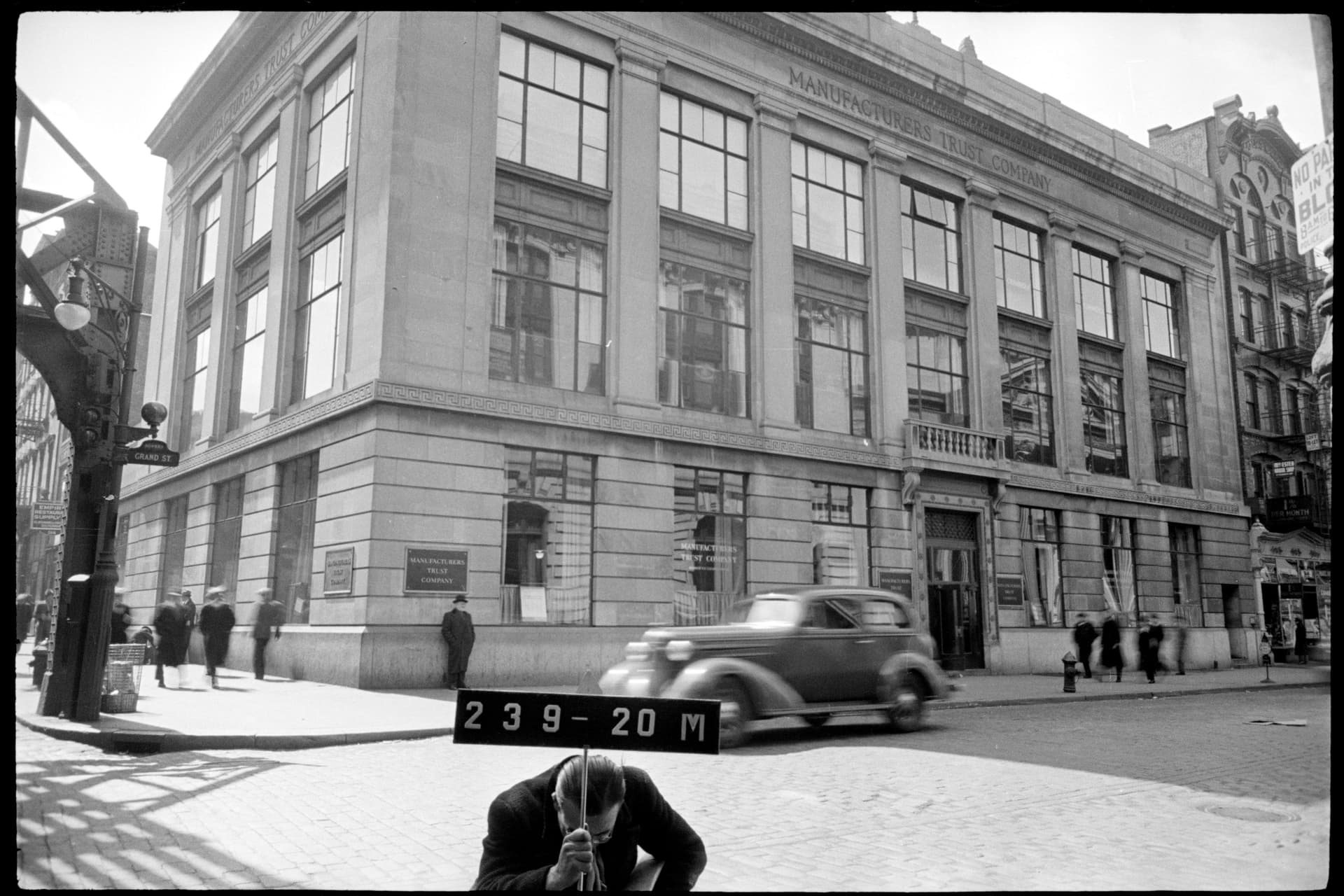
Manhattanville before the bulldozers
Manhattanville is a hollow in the Manhattan ridgeline. The neighborhood sits where the island’s spine dips from Morningside Heights down to the Hudson. The Hudson River Railroad followed the low ground along the water from 1849 onward, and the streets along the rail corridor grew up around industry that needed cheap land, rail access, and river water. Sheffield Farms opened the city’s first pasteurization plant at Broadway and West 125th Street in 1888.7 The Borden Condensed Milk Company and the McDermott-Bunger Dairy followed along the same corridor. By the 1910s Manhattanville’s western blocks housed a dairy-processing cluster that supplied much of Manhattan’s milk, butter, and ice cream.
The industrial base diversified through the 1920s. In 1923 the Studebaker Brothers Manufacturing Company opened an art-deco vehicle-assembly plant at 615 West 131st Street. In 1937 Studebaker sold the building to Borden, which converted it to milk processing.8 Yuengling had operated one of the city’s largest breweries at 1361 Amsterdam Avenue from the 1870s. The German-American architect Louis Oberlein rebuilt the brewery complex in 1905. Prohibition ended brewing in 1919, and the complex became, in succession, a dairy, a cold-storage warehouse, a laundry, and, by the 1930s, a fur-storage facility that gave the building its current name, the Mink Building.9 Hamilton Automotive and several other auto-sales and service businesses operated in the same industrial zone for most of the twentieth century.
The residential grid climbed the hill above the industry. Between Broadway and Amsterdam, on the blocks from West 125th to West 135th Streets, four- and five-story walk-up tenements housed a working-class population that was Irish and German through the 1910s, Jewish and Italian through the 1930s, and African-American, Puerto Rican, and Dominican from the 1940s onward.10 The northern boundary of the neighborhood has always been contested. The New York City Department of City Planning uses West 135th Street. Community Board 9 and some older real-estate sources extend the boundary as far north as West 142nd Street. The southern boundary at West 125th Street, the eastern boundary at Amsterdam Avenue, and the western boundary at the Hudson are stable across the sources.
The neighborhood that the first round of clearance hit in the 1950s was, by the standards of Manhattan in that decade, neither exceptionally dilapidated nor exceptionally well-off. Columbia conducted its own household survey of the blocks slated for the Grant Houses before demolition. More than half of the residents told the surveyors that they were mostly satisfied with their current housing and that overcrowding in the area was lower than in neighboring Harlem blocks.2 The designation of the blocks as a slum came from Morningside Heights Inc., the consortium of institutions that included Columbia, Barnard, the Jewish Theological Seminary, St. Luke’s Hospital, and the Cathedral of St. John the Divine. The consortium had organized in 1947 explicitly to protect the character of Morningside Heights from the Harlem population to the north.11 The consortium pushed NYCHA to build the Grant Houses and the Manhattanville Houses as a buffer between the institutional campus on the ridge and the working-class Black and Puerto Rican blocks along the river.
The Grant Houses, Morningside Gardens, and the 1950s displacement
The Grant Houses rose on a fifteen-acre superblock between West 123rd and West 125th Streets, Broadway and Morningside Avenue. Construction began in 1954. The first residents moved in as individual towers became habitable in 1956. NYCHA recorded the project as ninety-five-percent occupied by October 31, 1957.122 Ten brick-and-concrete towers held 1,940 apartments. The buildings still stand. The Grant Houses remain one of the largest NYCHA developments in Manhattan.
Morningside Gardens opened the same year on a six-tower site immediately south of the Grant Houses, between West 123rd Street and La Salle Street. The cooperative held 972 units for middle-income families, which the sponsors priced for purchase rather than rent. Morningside Heights Inc. had organized the sponsoring coalition. Columbia, Barnard, and the other consortium members placed employees in many of the units. The cooperative’s first tenant mix was approximately seventy-five percent white, twenty percent Black, four percent Asian, and one percent Puerto Rican, a racial composition the sponsors publicized as a model of integration.1
The slum-clearance program that cleared the sites removed the tenement population of the blocks in question. The aggregate figure across the Grant Houses site and the Morningside Gardens site is approximately seven thousand displaced residents, most of them African-American or Puerto Rican.1 NYCHA rehoused a fraction of the displaced families in the new Grant Houses apartments. The federal Housing Act of 1949 required that public-housing authorities offer displaced tenants priority access to the replacement units, and NYCHA complied, though the income ceilings and the reduced unit count left a substantial share of the original residents without a place in the new development. Morningside Gardens, as a middle-income cooperative, required a down payment and a monthly carrying charge that the displaced working-class tenants could not meet.
The planning scholars Hiba Bou Akar and Martine Johannessen have documented the full scale of the Morningside Heights slum-clearance program in a 2026 study in the Journal of Planning History, and the reconstruction below draws on their work.13 The program took roughly seventeen acres in total between 1953 and 1961, counting the Grant Houses, Morningside Gardens, the Manhattanville Houses completed in 1961, and a scattering of smaller institutional takings along Amsterdam Avenue. The demographic displacement exceeded the capacity of the replacement housing by a factor of more than two to one. The families whom the clearance pushed out of the area moved principally east into Central Harlem and north into Washington Heights.
Morningside Heights Inc. disbanded formally in 1979, but the consortium’s planning method persisted at Columbia. The next round of clearance arrived a quarter century later, under the same institutional driver, through the same legal tools, against what remained of the same community.
Manhattanville lies in West Harlem between 125th Street and Broadway on the south and east, and the Hudson River and 135th Street on the west and north. The Grant Houses and Morningside Gardens displaced roughly seven thousand residents in the 1950s. Columbia University's Manhattanville expansion, announced in 2003 and approved in 2007, took the remaining low-rise blocks between 125th and 133rd through purchase and eminent domain. West Harlem lost fourteen percent of its Black population between 2010 and 2020.
The map shows West Harlem, Manhattanville coverage, Columbia Manhattanville campus, 2003 onward, Grant Houses NYCHA, 1957, Morningside Gardens cooperative, 1957, Tuck-It-Away parcels, Kaur v. NY State UDC, 602 West 132nd Street, Kaur petitioner building, and Mink Building, preserved pre-expansion structure.
- West Harlem, Manhattanville coverage
- Columbia Manhattanville campus, 2003 onward
- Grant Houses NYCHA, 1957
- Morningside Gardens cooperative, 1957
- Tuck-It-Away parcels, Kaur v. NY State UDC
- 602 West 132nd Street, Kaur petitioner building
- Mink Building, preserved pre-expansion structure
Urban Renewal Atlas, illustrative coverage.; Seventeen-acre Columbia expansion footprint.; General Ulysses S. Grant Houses NYCHA, 1957 onward.; Middle-income cooperative on the 1953 to 1961 clearance.; Sprayregen parcels Columbia took through eminent domain in 2011.; Residential walk-up at the center of the Columbia Daily Spectator investigation.; Former Studebaker-Borden Building, one of three preserved structures..
The Columbia Manhattanville expansion, 2003 to 2008
Columbia University President Lee Bollinger announced the Manhattanville expansion in the summer of 2003. The plan called for a seventeen-acre satellite campus on the blocks from West 125th to West 133rd Streets, between Broadway and Twelfth Avenue. The university projected 6.8 million square feet of new academic space, a seventeen-year construction schedule, and a total project budget of 6.3 billion dollars. The Bollinger announcement framed the project as the university’s largest capital investment since the original Morningside Heights campus of the 1890s.314
The footprint of the proposed expansion overlapped almost exactly with the remaining low-rise industrial and residential blocks that the 1950s clearance had bypassed. The Mink Building, the Studebaker-Borden Building, the Tuck-It-Away self-storage facility, Hamilton Automotive, Dinosaur Bar-B-Que, Floridita Restaurant, several active warehouse operations, a Pentecostal church, and the residential walk-ups at 601 West 130th Street, 622 West 131st Street, 3301 Broadway, and 602 West 132nd Street sat inside the proposed campus perimeter.415
Columbia began the acquisition program quietly in 2002, a year before the public announcement, through a shell corporation that negotiated individual purchases and long-term leases with property owners. By the time Bollinger announced the plan in 2003, Columbia or its affiliates had already acquired control of a substantial fraction of the target area. By 2007 the university controlled approximately sixty-five percent of the footprint, and by 2008 the figure had reached roughly ninety percent.16 The remaining ten percent, the holdouts the university had not been able to buy, became the subject of the eminent-domain proceedings.
The principal holdouts were Nicholas Sprayregen, who operated four Tuck-It-Away self-storage locations inside the project area, and Parminder Kaur and Amanjit Kaur, who owned a gasoline service station on West 125th Street operated as Hamilton Automotive. Sprayregen and the Kaur family refused to sell at the prices Columbia offered. The university turned to the Empire State Development Corporation, the state agency with eminent-domain authority under the Urban Development Corporation Act, and requested condemnation. On December 18, 2008, the Empire State Development Corporation issued its findings and determination. The agency declared the project area blighted and approved the use of eminent domain against the remaining parcels.56
Community Board 9, the local advisory body with jurisdiction over Morningside Heights, Manhattanville, and Hamilton Heights, had already rejected the plan. On August 20, 2007, the board voted thirty-two to two against Columbia’s 197-c rezoning application. In its place the board forwarded its own plan, a 197-a framework the board had spent three years developing, that called for substantially more affordable housing, height restrictions along the river, and protections for existing industrial tenants.17 The New York City Department of City Planning and the New York City Council overrode Community Board 9 and approved Columbia’s 197-c plan on December 19, 2007. The Empire State Development Corporation determination followed a year later.
The Kaur litigation and the blight finding
The Kaur petitioners, Sprayregen, and a small group of other property owners filed suit in the New York Supreme Court, Appellate Division, First Department, against the Empire State Development Corporation determination. On December 3, 2009, the Appellate Division issued a three-to-two decision for the petitioners. Justice James Catterson wrote for the majority. The opinion rejected the blight finding on the merits and rejected the agency’s procedural record on the record as a whole.
Catterson’s opinion used language rare in New York appellate practice. The opinion described the blight designation as “mere sophistry,” found that the agency had been “biased in Columbia’s favor,” and concluded that the project had “always primarily concerned a massive capital project for Columbia” rather than a blight remediation in the public interest.618 The opinion observed that the agency had commissioned its blight study years after Columbia had announced the project and after the university had already acquired most of the footprint. The Appellate Division held the taking unconstitutional.
The Empire State Development Corporation and Columbia appealed. On June 24, 2010, the New York Court of Appeals reversed in a unanimous decision, Kaur v. New York State Urban Development Corporation. Judge Carmen Beauchamp Ciparick wrote for the court. Chief Judge Lippman and Judges Graffeo, Read, Pigott, and Jones joined the opinion. Judge Robert Smith concurred in the result in a separate opinion that distanced him from parts of the majority’s reasoning.519 The Court of Appeals held that the agency’s findings of blight and civic purpose were rational and entitled to deference under the Urban Development Corporation Act and under the Fifth Amendment as the Supreme Court had construed it in Kelo v. City of New London five years earlier.
The Court of Appeals ruling closed the federal and state legal avenues. The United States Supreme Court declined to hear the case on December 13, 2010. Columbia, through the Empire State Development Corporation, took possession of the Sprayregen and Kaur properties in 2011. The university paid the agency approximately seventeen million dollars for the Tuck-It-Away parcels in 2012, a figure Sprayregen had rejected three times during the voluntary-sale phase.20
The Kaur decision is now a standard reference in the law-review literature on post-Kelo eminent domain. The critique runs in two directions. The first critique, from property-rights scholars such as Ilya Somin and from the Institute for Justice, argues that the deferential posture Ciparick adopted hollowed out any meaningful judicial review of blight findings in New York, and that the decision in effect authorized the use of eminent domain for any project that a private institution could pair with a state agency willing to sign off on a blight study.21 The second critique, from the planning-history literature and from the West Harlem community-benefits scholarship, argues that the Kaur court failed to examine the planning narrative that Columbia had supplied the agency, and that it treated the university’s self-interested projection of blight as a neutral public finding.2223 Both critiques, across otherwise opposed political positions, reach the same conclusion. The Manhattanville record is a record of university-led eminent domain against a community of color.
The residents Columbia took
The land Columbia acquired through purchase and eminent domain between 2003 and 2012 held roughly 140 residential units at the time of the announcement. Columbia’s own environmental review acknowledged 132 units in the academic mixed-use area.24 The buildings at 601 West 130th Street, 602 West 132nd Street, 622 West 131st Street, and 3301 Broadway were the principal residential structures inside the project footprint.
The tenants of those buildings were a mix of Puerto Rican, Dominican, and African-American families, most of them long-term renters, several with rent-stabilized leases going back to the 1970s. Columbia negotiated relocation packages individually with each household through the late 2000s and early 2010s. The university commissioned a new building at 3333 Broadway, between West 133rd and West 135th Streets, and offered relocation tenants priority access to units there as their original apartments came down. The relocation terms included a moving stipend, a rent differential for a limited period, and, for rent-stabilized tenants, a legally equivalent rent-stabilized unit in the new building.7
The records on how the relocation unfolded in practice are partial. The Columbia Daily Spectator’s multi-year investigation of the residents of 602 West 132nd Street, published in November 2018, followed seventeen households from the original walk-up through the relocation period. The investigation found that most of the households accepted the packages. A minority held out. Against market-rate Manhattan rents five years later, the relocation compensation fell short of the economic position the tenants had held before Columbia bought the building.15 The Spectator investigation is the single most detailed account of the residential displacement in the public record.
Organizing groups, including the Coalition to Preserve Community and the West Harlem Environmental Action Group (WE ACT), documented the residential displacement through the 2007 to 2008 hearings cycle and through a series of rallies in 2006 and 2007. The Coalition to Preserve Community convened at St. Mary’s Church at 521 West 126th Street from the spring of 2003 onward. The coalition brought tenants, clergy, small-business owners, and Columbia students together on a single platform that demanded the withdrawal of the 197-c proposal, the adoption of Community Board 9’s 197-a plan, and a binding community-benefits agreement.25 On November 7, 2007, Columbia undergraduates opened a ten-day hunger strike on Butler Plaza in solidarity with the coalition’s demands. The strike ended on November 15 after Columbia agreed to principles on curriculum reform and ethnic studies, though the university declined the Manhattanville-specific demand that it withdraw the 197-c application.26
In May 2009 Columbia and the West Harlem Local Development Corporation signed the West Harlem community-benefits agreement, which followed from the coalition’s organizing and from the city’s procedural requirements under the 197-c rezoning approval. The agreement bound Columbia and the West Harlem Local Development Corporation, the nonprofit that Community Board 9 and local elected officials had convened as the community counterparty. Columbia committed $150 million over sixteen years for a benefits fund, an affordable-housing fund, a legal-assistance fund for displaced tenants, and an in-kind fund for academic partnerships with local schools.2728 The West Harlem Local Development Corporation later reorganized as the West Harlem Development Corporation, which administers the benefits fund.
West Harlem after the expansion
The Manhattanville campus opened in phases beginning in 2017. The Jerome L. Greene Science Center, the Lenfest Center for the Arts, the Forum, the David Geffen Hall, and the Business School buildings now occupy most of the seventeen acres. Columbia dedicated the campus formally in 2022.29 The Mink Building, the Studebaker-Borden Building, and the Prentis Hall former Sheffield Farms pasteurization plant survive as three of the pre-expansion structures the campus plan preserved. Nanka Shoten-style commercial-heritage preservation, the kind the Los Angeles Conservancy has pursued for Terminal Island’s Tuna Street, did not occur in Manhattanville. The pre-expansion commercial tenants dispersed.
The demographic change in the surrounding census tracts tracks the expansion closely. Community District 9, which contains Manhattanville, Hamilton Heights, and Morningside Heights, lost approximately fourteen percent of its Black population, about 3,800 residents, between the 2010 and 2020 censuses. The district lost approximately ten percent of its Latinx population, about 4,500 residents, in the same period.30 The combined loss of Black and Latinx residents across the wider Harlem area, East, Central, and West, was 10,805 people. The white population in the same area grew by 18,754. Columbia alone did not drive the change. Market-rate conversion of rent-stabilized housing, speculative investment, and NYCHA disinvestment all contributed. The expansion was the anchor event inside the larger pattern.
Critics, the New York Attorney General’s office, and Community Board 9 have contested the West Harlem Development Corporation’s record as the steward of the community-benefits agreement throughout its operational life. The New York Attorney General’s office investigated the corporation’s spending in 2012. Kofi Boateng, the first executive director, departed in late 2020 under criticism from the Community Service Society of New York, from Community Board 9, and from Manhattan Borough President Gale Brewer, for weak leadership and poor investment decisions.31 The corporation fired its Housing Development Fund Corporation Resource Center director, Vince Morgan, in January 2025. Morgan alleged that the firing retaliated against a whistleblower report he had filed on the corporation’s internal financial controls.32 A 2025 study in the Journal of Planning Education and Research by Nicholas Robinson argues that the structural defect in the West Harlem community-benefits agreement is the absence of any public-accountability mechanism for the nonprofit intermediary.23 The $150 million figure remains intact on paper. The question the community asked in 2007, whether the money reaches the people the expansion displaced, remains open.
What the Manhattanville record teaches
The Manhattanville record is one of a small number of twenty-first-century cases in which an American elite research university has used eminent domain against a surrounding community of color at this scale. The New York University expansion into Greenwich Village produced comparable conflict at a smaller scale. The University of Chicago’s South Campus expansion in the early 2000s took a smaller footprint through largely voluntary purchase. The University of Pennsylvania’s West Philadelphia expansion in the 1960s took a larger residential footprint, but under federal urban-renewal authority rather than state-administered eminent domain. The Columbia Manhattanville case, alongside the 1950s Morningside Heights slum-clearance record, represents the most sustained university-led displacement of a single urban neighborhood in the postwar American city.
The case teaches four lessons for present-day fights against institutional expansion.
The first lesson is that the community-benefits agreement, as a procedural mechanism, operates within the constraints the institution sets. The West Harlem community-benefits agreement produced real benefits in the form of scholarship funds, neighborhood legal assistance, and affordable-housing subsidies. It did not produce the outcome the Coalition to Preserve Community demanded, the withdrawal of the 197-c application or the adoption of the 197-a plan. Community counterparties have to negotiate the benefits agreement on the terms of the original expansion, not on the terms of whether the expansion happens. Community Board 9’s 197-a plan remains the more consequential organizing document. Plans beat agreements.
The second lesson is that the appellate-court record matters, and that property-rights-framed litigation can produce rhetorical and evidentiary records that later community organizing can use. Justice Catterson’s 2009 opinion called the Empire State Development Corporation record “mere sophistry.” The Court of Appeals reversed Catterson on the law, but it did not contest his factual findings. The lower-court opinion is a usable artifact in present-day organizing against similar university expansions.
The third lesson is that acquisition in advance of public announcement is the institutional standard operating procedure. Columbia acquired the majority of the Manhattanville footprint through quiet purchases and shell-corporation deals before the Bollinger announcement in 2003. The New York University Greenwich Village expansion followed the same pattern. The Amazon HQ2 Long Island City bid in 2018 followed the same pattern. The only defense against pre-announcement acquisition is a public registry of institutional purchases above a threshold, a tool the Community Service Society of New York and the Pratt Center for Community Development have proposed repeatedly.33
The fourth lesson is that the organizing infrastructure survives the expansion. The Coalition to Preserve Community dissolved as a distinct entity in the early 2010s, but its members persisted in WE ACT, in the West Harlem Environmental Action Coalition, in the Manhattan Community Board 9 Columbia Expansion Committee, and in Manhattan Borough Board housing-policy working groups. Two of the coalition’s organizers, Tom DeMott and Nellie Bailey, continued to organize West Harlem tenants through the 2010s and 2020s under the banner of the Harlem Tenants Council. The scholarship, the oral histories, and the archival documentation that the coalition and its allies produced remain public.34
The Manhattanville case is present and active. Columbia, Community Board 9, and West Harlem elected officials are negotiating the fourth phase of the Columbia campus, the proposed thirty-four-story tower at Broadway and West 125th Street, as of 2026. Community Board 9 is scrutinizing the West Harlem Development Corporation board. The residents of the surviving pre-expansion buildings along Broadway and Amsterdam continue to organize against market-rate conversion. The record of what Columbia and NYCHA took from the neighborhood, and the record of what the community preserved in defense of itself, is in public hands. The work of the present organizers is the continuation of the work their grandparents did against Morningside Heights Inc. seventy years earlier.
Footnotes
-
Wikipedia, “Morningside Gardens.” https://en.wikipedia.org/wiki/Morningside_Gardens ↩ ↩2 ↩3
-
Wikipedia, “Grant Houses.” https://en.wikipedia.org/wiki/Grant_Houses ↩ ↩2 ↩3
-
WikiCU, “Manhattanville campus.” https://www.wikicu.com/Manhattanville_campus ↩ ↩2
-
UN-Habitat, “Columbia University Expansion into West Harlem, New York City.” https://unhabitat.org/sites/default/files/download-manager-files/NYC%20Case%20Study.pdf ↩ ↩2
-
Matter of Kaur v New York State Urban Dev. Corp., 15 N.Y.3d 235 (2010). https://www.nycourts.gov/reporter/3dseries/2010/2010_05601.htm ↩ ↩2 ↩3
-
Kaur v New York State Urban Dev. Corp., 2009 NY Slip Op 08976, Appellate Division, First Department. https://law.justia.com/cases/new-york/appellate-division-first-department/2009/2009-08976.html ↩ ↩2 ↩3
-
Columbia University, “History | Columbia Neighbors.” https://neighbors.columbia.edu/content/history ↩ ↩2
-
City Lore, “Studebaker Building.” https://citylore.org/places/studebaker-building/ ↩
-
Wikipedia, “Mink Building.” https://en.wikipedia.org/wiki/Mink_Building ↩
-
Wikipedia, “Manhattanville, Manhattan.” https://en.wikipedia.org/wiki/Manhattanville,_Manhattan ↩
-
Tom Angotti, “Columbia University’s Expansion and the Struggle for the Future of Harlem,” Planners Network, October 2009. https://www.plannersnetwork.org/2009/10/columbia-universitys-expansion-and-the-struggle-for-the-future-of-harlem/ ↩
-
Ulysses S. Grant Houses Residents Association, “About Us.” https://granthouses.com/about-us/ ↩
-
Hiba Bou Akar and Martine Johannessen, “The Making of a Split City: Planning, Urban Renewal, and Resistance in the Spatial Production of Morningside Heights, New York City,” Journal of Planning History, 2026. https://journals.sagepub.com/doi/10.1177/15385132251397624 ↩
-
Engineering News-Record, “Court Approves Eminent Domain for $6.3 billion Columbia U. Expansion,” August 1, 2010. https://www.enr.com/articles/20590-court-approves-eminent-domain-for-6-3-billion-columbia-u-expansion ↩
-
Columbia Daily Spectator, “After Displacement from Manhattanville, a Community Remains Resilient,” November 16, 2018. https://www.columbiaspectator.com/the-eye/2018/11/16/what-happened-to-the-residents-of-602-west-132nd-st/ ↩ ↩2
-
Progressive City: Radical Alternatives, “From West Harlem to Manhattanville: Columbia University as Planner, Occupier, and Developer.” https://progressivecity.net/from-west-harlem-to-manhattanville-columbia-university-as-planner-occupier-and-developer/ ↩
-
Manhattan Community Board 9, “197-A Plan.” https://www.cb9m.org/197a_plan ↩
-
Damon Root, “The Blight Stops Here?” Reason, May 27, 2010. https://reason.com/2010/05/27/the-blight-stops-here/ ↩
-
Cornell Law School, “No. 125: Matter of Kaur v New York State Urban Dev. Corp.” https://www.law.cornell.edu/nyctap/I10_0123.htm ↩
-
Daniel Geiger, “Columbia University strikes $34M deal with Gerald Sprayregen for Manhattanville property,” Crain’s New York Business. https://www.crainsnewyork.com/real-estate/columbia-university-strikes-34m-deal-manhattanville-property ↩
-
Institute for Justice, “U.S. Supreme Court Decides Whether to Hear New York Eminent Domain Abuse Case,” December 6, 2010. https://ij.org/press-release/tuck-it-away-release-12-6-10/ ↩
-
Journal of Civil Rights and Economic Development, “Grim Toll: A Case Commentary on Kaur v. New York State Urban Development Corp.” https://www.jcred.org/shortreads/grim-toll-a-case-commentary-on-kaur-v-new-york-state-urban-development-corp ↩
-
Nicholas A. Robinson, “Bargaining for Benefits: The Dilemmas of Implementing the West Harlem Community Benefits Agreement,” Journal of Planning Education and Research, 2025. https://journals.sagepub.com/doi/10.1177/10780874251315105 ↩ ↩2
-
New York City Department of City Planning, “Manhattanville in West Harlem Rezoning and Academic Mixed-Use Development Final Environmental Impact Statement, Chapter 4: Socioeconomic Conditions.” https://www.nyc.gov/assets/planning/download/pdf/applicants/env-review/manhattanville/04.pdf ↩
-
The Indypendent, “Columbia Expansion 101: Wealthy University Devours West Harlem,” August 2007. https://indypendent.org/2007/08/columbia-expansion-101-wealthy-university-devours-west-harlem/ ↩
-
WikiCU, “2007 hunger strike.” https://www.wikicu.com/2007_hunger_strike ↩
-
Columbia University Office of Public Affairs, “Community Benefits Agreement.” https://communications.news.columbia.edu/content/community-benefits-agreement ↩
-
Columbia University, “Community Commitments | Columbia Neighbors.” https://neighbors.columbia.edu/content/community-commitments ↩
-
Columbia University, “Columbia University Dedicates Its 17-Acre Manhattanville Campus, Establishing Its Academic and Civic Aspirations for a Century to Come.” https://neighbors.columbia.edu/news/columbia-university-dedicates-its-17-acre-manhattanville-campus-establishing-its-academic-and ↩
-
Community Service Society of New York, “Examining West Harlem: Demographic and Economic Changes.” https://www.cssny.org/news/entry/examining-west-harlem-demographic-and-economic-changes ↩
-
Columbia Daily Spectator, “Amid accusations of weak leadership and poor investments, Kofi Boateng leaves the West Harlem Development Corporation,” December 7, 2020. https://www.columbiaspectator.com/city-news/2020/12/07/amid-accusations-of-weak-leadership-and-poor-investments-kofi-boateng-leaves-the-west-harlem-development-corporation/ ↩
-
Columbia Daily Spectator, “HDFC Resource Center director fired amid community dissatisfaction with parent organization,” February 17, 2025. https://www.columbiaspectator.com/city-news/2025/02/17/hdfc-resource-center-director-fired-amid-community-dissatisfaction-with-parent-organization/ ↩
-
Community Service Society of New York, “Harlem Activists Aim to Tap The Brakes On Columbia Expansion,” July 2024. https://www.cssny.org/news/entry/harlem-activists-aim-to-tap-the-brakes-on-columbia-expansion ↩
-
Tom Angotti, New York for Sale: Community Planning Confronts Global Real Estate, MIT Press, 2008. ↩
Sources
Schomburg Center for Research in Black Culture. (2024). "Digital Collections".
https://www.nypl.org/locations/schomburgPrimary collection on African-American history in New York.
Wikipedia contributors. (2025). "Morningside Gardens".
https://en.wikipedia.org/wiki/Morningside_GardensEntry covers 1954–1957 construction, displacement figures, and Morningside Heights Inc. sponsorship.
Wikipedia contributors. (2025). "Grant Houses".
https://en.wikipedia.org/wiki/Grant_HousesEntry cites NYCHA occupancy records showing October 31, 1957 completion and the pre-clearance Columbia household survey.
WikiCU. (2024). "Manhattanville campus".
https://www.wikicu.com/Manhattanville_campusColumbia University internal wiki entry documenting 2003 Bollinger announcement and project scope.
UN-Habitat. (2016). "Columbia University Expansion into West Harlem, New York City".
https://unhabitat.org/sites/default/files/download-manager-files/NYC%20Case%20Study.pdfUN-Habitat case study on the Manhattanville expansion as an example of institutional-led displacement.
New York Court of Appeals. (2010). "Matter of Kaur v. New York State Urban Dev. Corp., 15 N.Y.3d 235".
https://www.nycourts.gov/reporter/3dseries/2010/2010_05601.htmOpinion by Judge Ciparick upholding eminent domain for Columbia expansion. Judge Smith concurred in result in a separate opinion.
New York Appellate Division, First Department. (2009). "Matter of Kaur v. New York State Urban Dev. Corp., 2009 NY Slip Op 08976".
https://law.justia.com/cases/new-york/appellate-division-first-department/2009/2009-08976.htmlJustice Catterson majority opinion, 3-2, striking down the ESDC blight determination as "mere sophistry." Later reversed by Court of Appeals.
New York City Housing Authority. (2024). "Photograph Collection, LaGuardia and Wagner Archives".
https://www.laguardiawagnerarchive.lagcc.cuny.edu/NYCHA photographic record of pre-clearance Manhattanville blocks and Grant Houses construction, held at LaGuardia Community College.
Columbia University. (2024). "History | Columbia Neighbors".
https://neighbors.columbia.edu/content/historyUniversity-facing history of the Manhattanville neighborhood, dairy industry, and Sheffield Farms pasteurization plant.
City Lore. (2022). "Studebaker Building".
https://citylore.org/places/studebaker-building/Documentation of the 1923 Studebaker Brothers Manufacturing Company building at 615 West 131st Street.
Wikipedia contributors. (2025). "Mink Building".
https://en.wikipedia.org/wiki/Mink_BuildingEntry documents the 1905 Oberlein reconstruction of the Yuengling brewery complex at 1361 Amsterdam Avenue and its subsequent uses.
Wikipedia contributors. (2025). "Manhattanville, Manhattan".
https://en.wikipedia.org/wiki/Manhattanville,_ManhattanNeighborhood entry documenting boundaries and successive demographic waves.
Tom Angotti. (2009). "Columbia University's Expansion and the Struggle for the Future of Harlem". Planners Network.
https://www.plannersnetwork.org/2009/10/columbia-universitys-expansion-and-the-struggle-for-the-future-of-harlem/Angotti's critical analysis of Morningside Heights Inc. and the 2000s expansion.
Ulysses S. Grant Houses Residents Association. (2024). "About Us".
https://granthouses.com/about-us/Residents association history of the Grant Houses.
Hiba Bou Akar, Martine Johannessen. (2026). "The Making of a Split City: Planning, Urban Renewal, and Resistance in the Spatial Production of Morningside Heights, New York City". Journal of Planning History.
https://journals.sagepub.com/doi/10.1177/15385132251397624Scholarly reconstruction of Morningside Heights Inc. slum-clearance program, 1947–1961.
Engineering News-Record. (2010). "Court Approves Eminent Domain for $6.3 billion Columbia U. Expansion".
https://www.enr.com/articles/20590-court-approves-eminent-domain-for-6-3-billion-columbia-u-expansionIndustry trade-press coverage of the Kaur decision and project budget.
Columbia Daily Spectator, The Eye. (2018). "After Displacement from Manhattanville, a Community Remains Resilient". Columbia Daily Spectator.
https://www.columbiaspectator.com/the-eye/2018/11/16/what-happened-to-the-residents-of-602-west-132nd-st/Multi-year investigation of the seventeen households displaced from 602 West 132nd Street.
Progressive City: Radical Alternatives. (2024). "From West Harlem to Manhattanville: Columbia University as Planner, Occupier, and Developer".
https://progressivecity.net/from-west-harlem-to-manhattanville-columbia-university-as-planner-occupier-and-developer/Analytical account of Columbia acquisition strategy and shell-corporation purchases.
Manhattan Community Board 9. (2024). "197-A Plan".
https://www.cb9m.org/197a_planCommunity Board 9 alternative community-planning framework for Manhattanville.
Damon Root. (2010). "The Blight Stops Here?". Reason Magazine.
https://reason.com/2010/05/27/the-blight-stops-here/Property-rights critique of Kaur with quotations from Catterson opinion.
Cornell Law School Legal Information Institute. (2010). "No. 125: Matter of Kaur v New York State Urban Dev. Corp.".
https://www.law.cornell.edu/nyctap/I10_0123.htmCornell LII case summary of the June 24, 2010 Court of Appeals decision.
Daniel Geiger. (2021). "Columbia University strikes $34M deal with Gerald Sprayregen for Manhattanville property". Crain's New York Business.
https://www.crainsnewyork.com/real-estate/columbia-university-strikes-34m-deal-manhattanville-propertyCoverage of post-eminent-domain Sprayregen property transactions.
Institute for Justice. (2010). "U.S. Supreme Court Decides Whether to Hear New York Eminent Domain Abuse Case".
https://ij.org/press-release/tuck-it-away-release-12-6-10/Institute for Justice press release on cert petition denial.
Journal of Civil Rights and Economic Development. (2011). "Grim Toll: A Case Commentary on Kaur v. New York State Urban Development Corp.". Journal of Civil Rights and Economic Development.
https://www.jcred.org/shortreads/grim-toll-a-case-commentary-on-kaur-v-new-york-state-urban-development-corpLegal commentary on the Kaur decision.
Nicholas A. Robinson. (2025). "Bargaining for Benefits: The Dilemmas of Implementing the West Harlem Community Benefits Agreement". Journal of Planning Education and Research.
https://journals.sagepub.com/doi/10.1177/10780874251315105Structural critique of the WHDC as a nonprofit intermediary administering community-benefits funds.
New York City Department of City Planning. (2007). "Manhattanville in West Harlem Rezoning and Academic Mixed-Use Development Final Environmental Impact Statement, Chapter 4: Socioeconomic Conditions".
https://www.nyc.gov/assets/planning/download/pdf/applicants/env-review/manhattanville/04.pdfOfficial city environmental-review socioeconomic chapter, including residential-unit counts inside the project area.
The Indypendent. (2007). "Columbia Expansion 101: Wealthy University Devours West Harlem". The Indypendent.
https://indypendent.org/2007/08/columbia-expansion-101-wealthy-university-devours-west-harlem/Contemporary movement reporting on Coalition to Preserve Community.
WikiCU. (2024). "2007 hunger strike".
https://www.wikicu.com/2007_hunger_strikeInternal Columbia wiki record of the November 7–15, 2007 student hunger strike.
Columbia University Office of Public Affairs. (2024). "Community Benefits Agreement".
https://communications.news.columbia.edu/content/community-benefits-agreementOfficial Columbia summary of the May 2009 CBA.
Columbia University. (2024). "Community Commitments | Columbia Neighbors".
https://neighbors.columbia.edu/content/community-commitmentsColumbia's public accounting of community commitments associated with the Manhattanville expansion.
Columbia University. (2022). "Columbia University Dedicates Its 17-Acre Manhattanville Campus".
https://neighbors.columbia.edu/news/columbia-university-dedicates-its-17-acre-manhattanville-campus-establishing-its-academic-andAnnouncement of campus dedication.
Community Service Society of New York. (2024). "Examining West Harlem: Demographic and Economic Changes".
https://www.cssny.org/news/entry/examining-west-harlem-demographic-and-economic-changesCSS census analysis of Community District 9 between 2010 and 2020.
Columbia Daily Spectator. (2020). "Amid accusations of weak leadership and poor investments, Kofi Boateng leaves the West Harlem Development Corporation". Columbia Daily Spectator.
https://www.columbiaspectator.com/city-news/2020/12/07/amid-accusations-of-weak-leadership-and-poor-investments-kofi-boateng-leaves-the-west-harlem-development-corporation/Departure of WHDC's first executive director under community criticism.
Columbia Daily Spectator. (2025). "HDFC Resource Center director fired amid community dissatisfaction with parent organization". Columbia Daily Spectator.
https://www.columbiaspectator.com/city-news/2025/02/17/hdfc-resource-center-director-fired-amid-community-dissatisfaction-with-parent-organization/Termination of Vince Morgan and allegations of whistleblower retaliation at WHDC.
Community Service Society of New York. (2024). "Harlem Activists Aim to Tap The Brakes On Columbia Expansion".
https://www.cssny.org/news/entry/harlem-activists-aim-to-tap-the-brakes-on-columbia-expansionContemporary organizing against phase four of the Columbia expansion.
Tom Angotti. (2008). "New York for Sale: Community Planning Confronts Global Real Estate". MIT Press.
Framing work on community planning against real-estate-led development in New York.
Inside Self-Storage. (2009). "New York Eminent-Domain Agency Takes Tuck-It-Away Self Storage to Court".
https://www.insideselfstorage.com/companies-and-products/new-york-eminent-domain-agency-takes-tuck-it-away-self-storage-courtIndustry trade-press coverage of the ESDC Tuck-It-Away proceedings.